
A Tribal Mask Drawing That Carries Real Heritage
Most mask art I came across online felt hollow to me — a shape pulled out of context, flattened into decoration, drawn quickly and forgotten just as fast. That bothered me. A face that once held ceremony and meaning deserves more than a careless outline, and that conviction is where my work begins.
A tribal mask drawing — made with genuine respect and craft — is one of the most powerful subjects an artist can draw african mask art with using pen and ink.
I use the term “tribal” while being aware of its limitations. In African cultural contexts, the masks we often call tribal were made by specific communities with specific identities, not generic “tribes.” But the phrase is used so widely to describe this category of work that I engage with it openly, while trying to bring a more nuanced understanding to how I create these illustrations.
Every piece I make starts with that awareness, and I think you can feel it in the finished work.
What a Tribal Mask Drawing Demands
A good tribal mask drawing asks for several things at once. It asks for visual accuracy — a genuine engagement with the proportions, patterns, and headdress forms of the tradition being referenced. It asks for cultural respect — an awareness that what you are drawing carries meaning that was not invented for an artist’s convenience. And it asks for real craft — the kind that takes time and leaves the evidence of that time inside the finished image.
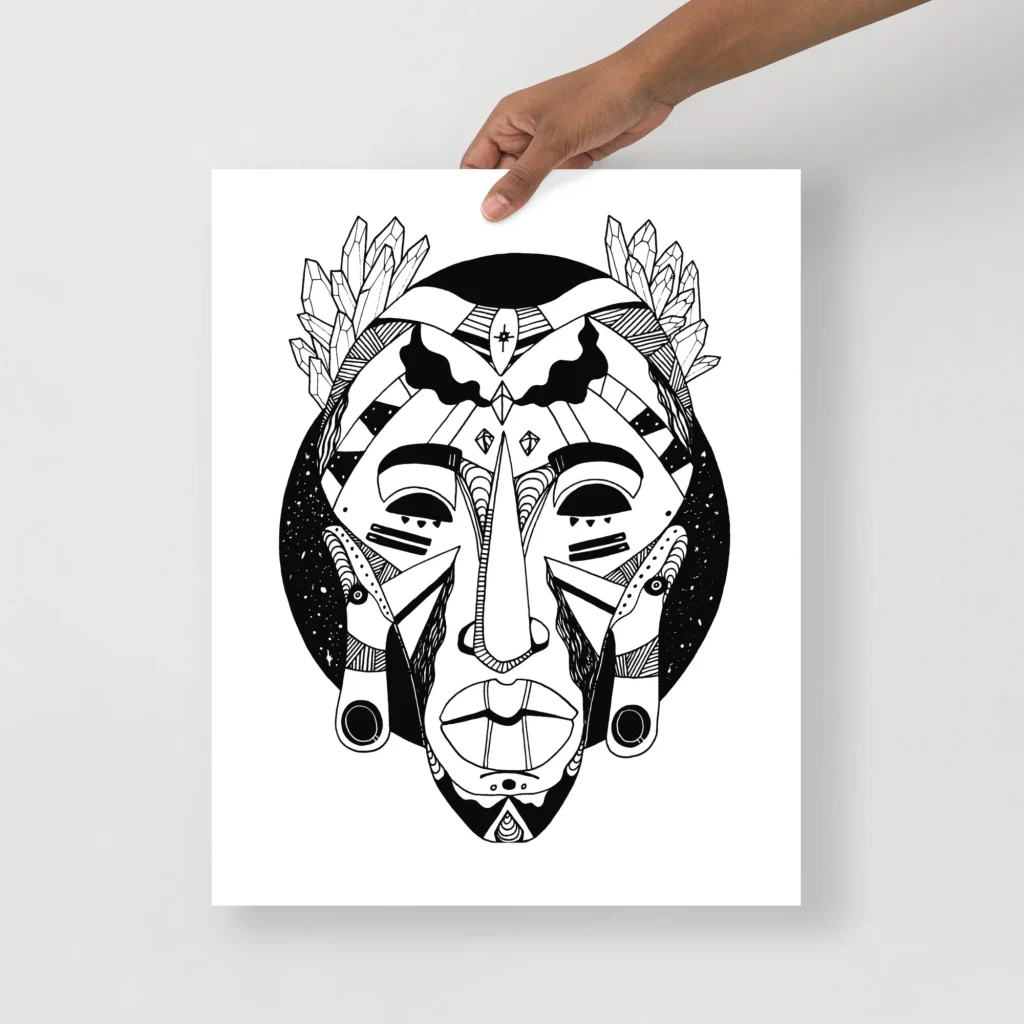
My process uses African mask design in pen and ink, black and white, entirely by hand. I build each image slowly — establishing the overall structure first, then working through the surface patterns, and finally developing the headdress elements that crown the composition. A single piece can take many hours of concentrated, uninterrupted work, and I would not have it any other way.
That time stays present in the result. You can see it in the density of the geometric fills that cover the face and surround the form. You can see it in the precision of the headdress linework, where each element is placed deliberately rather than gestured at. And you can feel it in the quality of presence the image projects from the wall — the sense that something careful and considered is looking back at you.
The Cultural Grounding Behind My Work
My practice draws specifically from West African ceremonial mask traditions — from the visual languages of cultures that developed the mask form into one of the most sophisticated artistic achievements in human history. These are traditions with deep ceremonial, spiritual, and communal significance, and I approach them as a student as much as an artist.
I come to this subject as a Haitian-American artist whose heritage traces through the African diaspora. Making a tribal mask drawing is, for me, an act of understanding the types of African masks that have always been part of my story — even when that story was interrupted by the forced dislocations of history. There is something personally meaningful about rendering these forms with care and precision, about insisting on their beauty and complexity through the slow, deliberate medium of pen and ink.
Black and White as Artistic Conviction
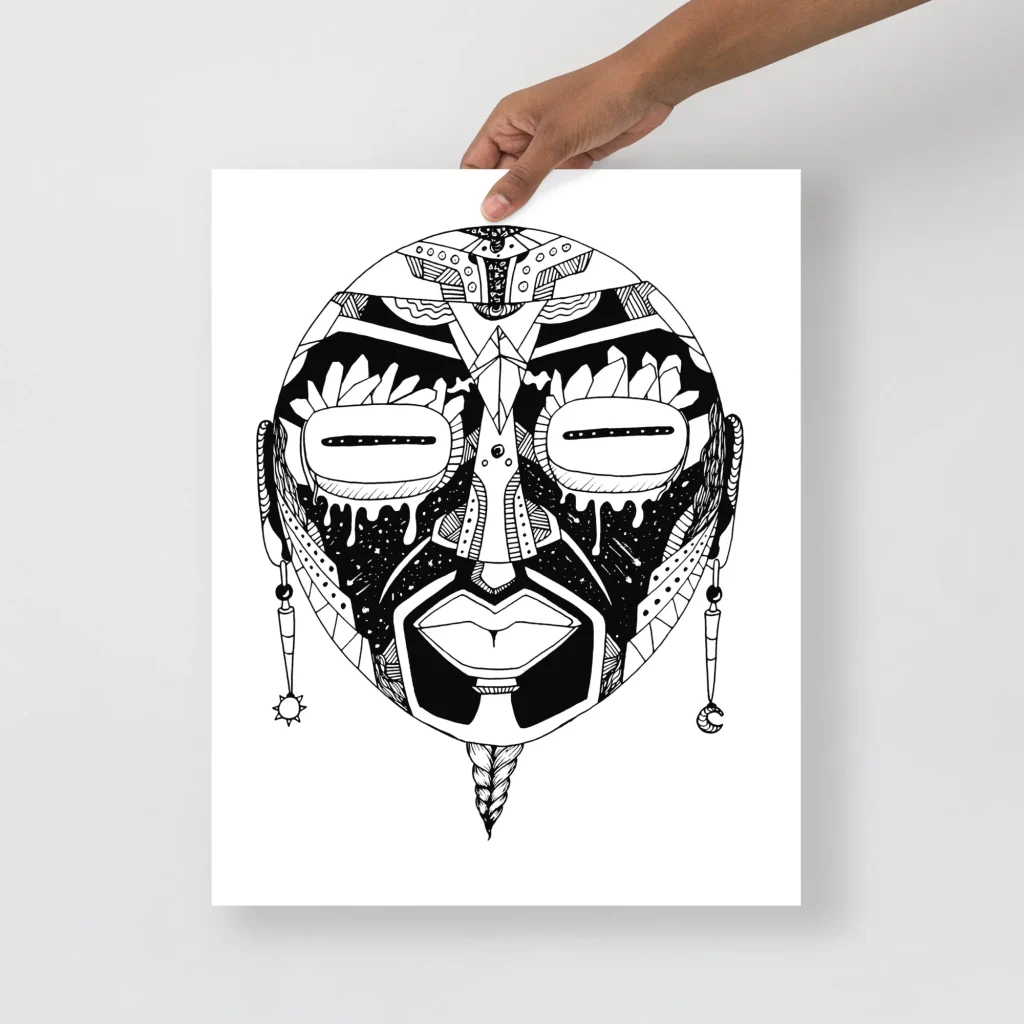
I chose African art in black and white for all of this work because it honors the essential visual logic of the tradition. Here, form and geometry carry the meaning — the bold outlines that define the face, the intricate patterns that fill every surface, the strong contrast between the dense black fills and the open white of the paper. Color would only compete with that language rather than serve it.
Black and white pen and ink is, I genuinely believe, the most honest format for this subject. It strips the image down to what matters: structure, pattern, and presence. Nothing hides behind a palette — the drawing has to stand on its own.
What a Tribal Mask Drawing Adds to a Wall
A bold black and white tribal mask drawing adds something to a wall that almost no other piece of art can replicate: the sense of being looked at by something that has been looking at things for a very long time.
This is not a mystical claim. It is an observation about how the mask form functions visually. A face on a wall engages the viewer — the eyes, even when stylized or geometric, create a sense of encounter. But a mask face engages differently from a portrait or a photograph. It is present as a cultural force, not an individual personality. The viewer meets something collectively made and ceremonially charged, not a private face. That distinction changes the entire experience of living with the piece.
It also has the quality of being visually complex in a way that rewards continued attention. The dense geometric fills, the detailed headdress, the individual marks that build up the surrounding field — all of these create a piece that gives more the longer you look at it. It is the kind of art that grows more interesting with time, not less. New details surface. The internal logic of the pattern becomes clearer. The relationship between the bold outer forms and the fine inner marks begins to feel almost architectural.
That layered experience is something I think about deliberately while I draw. I want the first impression — bold, graphic, immediate — to be followed by a second impression, and a third. I want the piece to hold your attention rather than exhaust it.
The Pieces in This Collection
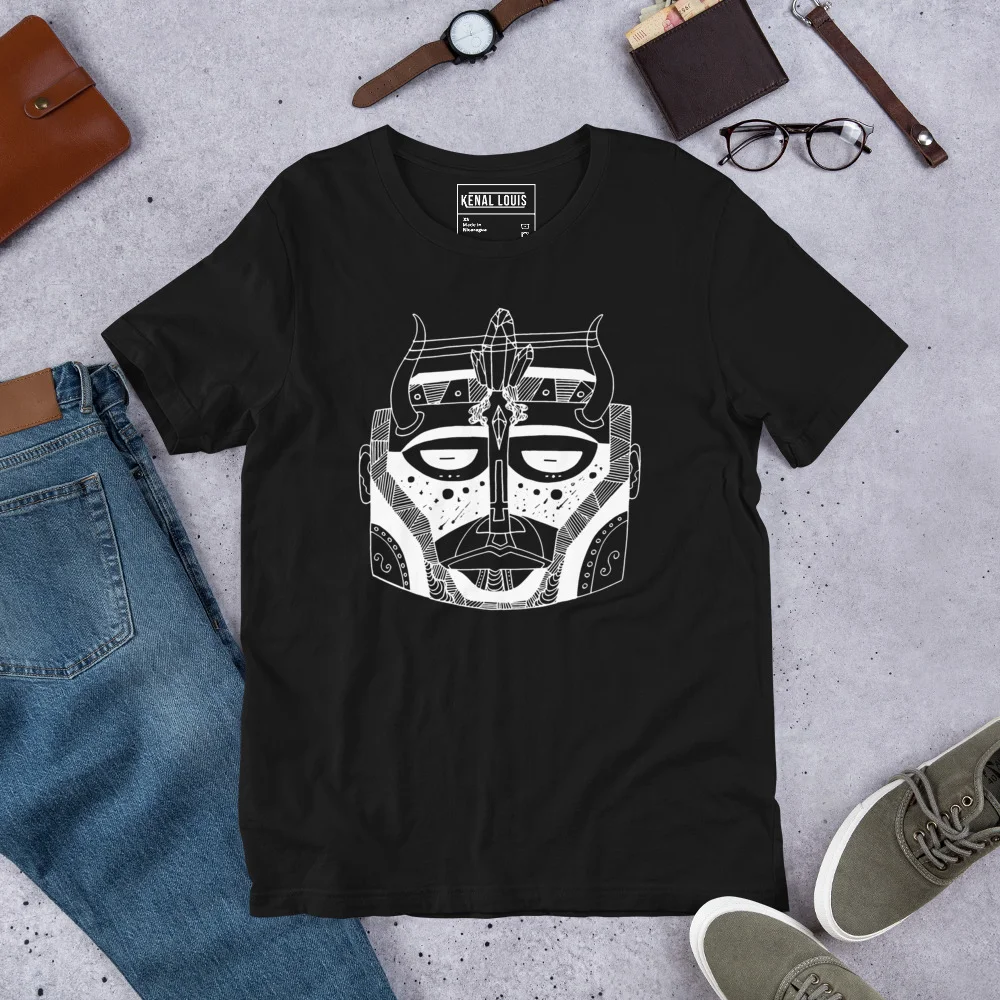
The three pieces featured here represent different ways of living with this work — and, honestly, different ways of giving it. The African Mask Art Print – Tribal Pen ink drawing is the fine art print edition, the drawing at its most direct, rendered in bold pen and ink and printed for the wall. The African Mask Art Print No. 2 – Tribal Wall Art continues that series with a second composition, different in its headdress and surface patterning but consistent in its approach and conviction. And the African Mask T-Shirt – Mask No.8 White Line Art Tee brings the mask into wearable form — white line art on a tee that carries the same visual energy as the prints in an entirely different context.
If you are searching for a gift that means something — for a brother reconnecting with his roots, a friend furnishing a first home, or anyone who feels the pull of African heritage — one of these pieces speaks quietly and lasts. A print for the wall on a birthday, a tee for someone who carries their pride out into the world; the work fits the moment without trying too hard.
Shop Tribal Mask Drawing Prints at kenallouis.com/
My prints are available as fine art prints, canvas wall art, and apparel. All editions are limited — so if something speaks to you, don’t wait. Visit kenallouis.com/ and support a Black artist celebrating African heritage through original art.
And when you hang one, notice the eyes again — the same steady presence I described at the start, now looking back at you from your own wall.