
The Masks That Shape My Work
What is this mask actually trying to say to me? That was the question I kept asking myself, pencil in hand, before a single line ever hit the page. For me, understanding the types of African masks has never been academic — it is the foundation of everything I create in this series.
When I began drawing African mask imagery in pen and ink, I spent long stretches simply looking. Not as an anthropologist cataloging objects behind glass, but as an artist trying to understand what the visual choices in each mask were communicating, and why a carver decided one curve should be sharp and another soft.
That kind of looking changed how I draw. It slowed me down in the best way.
The Categories I Draw From Most
There are far too many traditions to ever fully catalogue, but a few categories have shaped my hand more than any others.
Face masks are the most common form found across many cultures. They cover the wearer’s face directly and tend to be the most visually expressive, with deliberate proportional choices that communicate spiritual identity. My tall, vertical illustrations grow out of this lineage. In my African Mask Art Print – Tribal Pen ink drawing, you can see how I lean into those elongated proportions and bold linework — every stroke intentional, echoing the way traditional carvers used form itself as a kind of language.
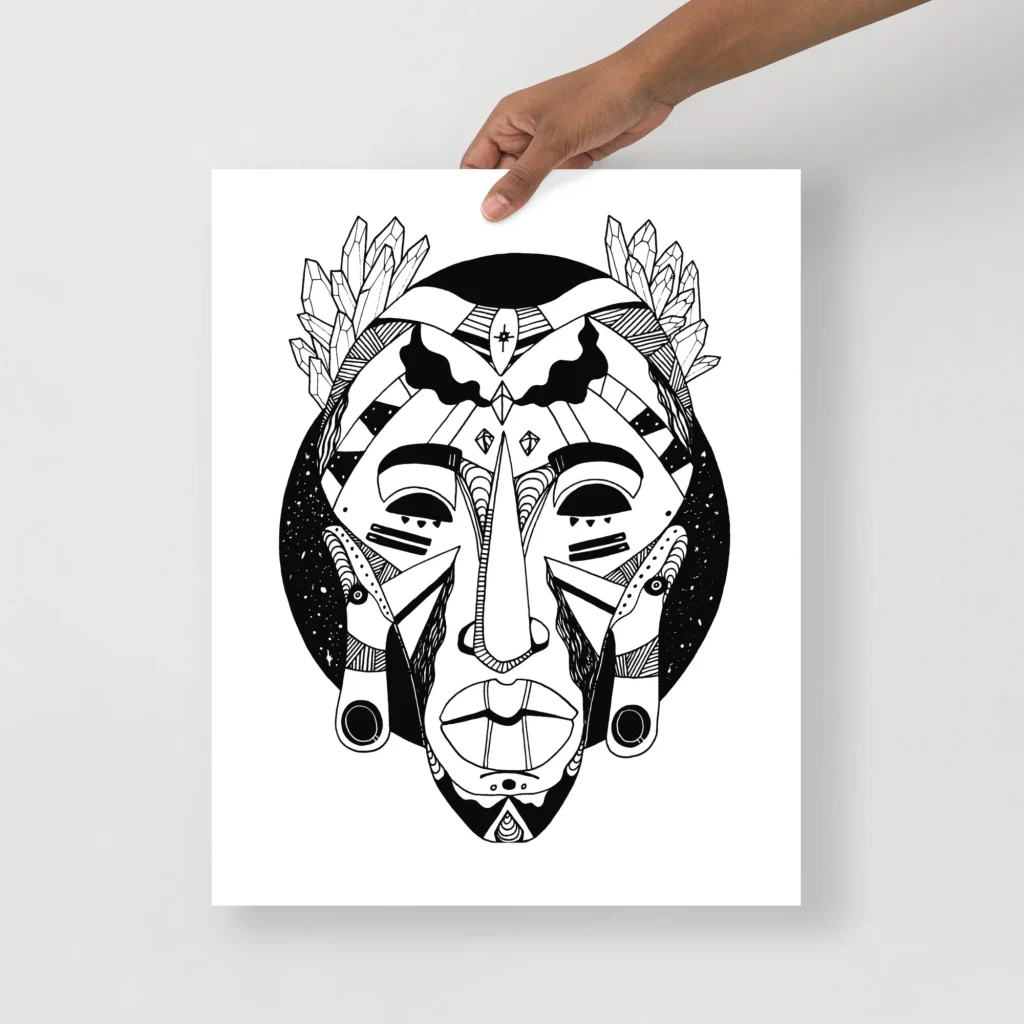
Then there are the headdress masks, which extend dramatically above the head and create a vertical statement you can read from across a crowded ceremony. The crystal and feather headdresses in my illustrations reference that upward energy — that sense of reaching, of connecting the wearer to something greater than themselves. When I render these in pen and ink, I keep reminding myself that the upward movement was never purely decorative. It was directional. It pointed somewhere on purpose.
Cosmic and elemental masks pull symbols straight from the natural world — sun, moon, animal forms, celestial imagery — to signal a connection to forces beyond the human. These are some of my favorite types of African masks to study. My sun-and-moon compositions come directly out of this category, and the African Mask Sweatshirt – White Line Art Afrocentric Pullover carries that same celestial feeling into something you can wear.
Why This Understanding Matters to My Practice
Knowing the difference between these forms is what keeps the work from going generic on me. If I am drawing from a specific visual language, I want to understand what that language is actually saying — not just what it looks like at a glance. There is a real difference between borrowing an aesthetic and genuinely engaging with a tradition, and I hold myself to that line every single time I sit down to draw.
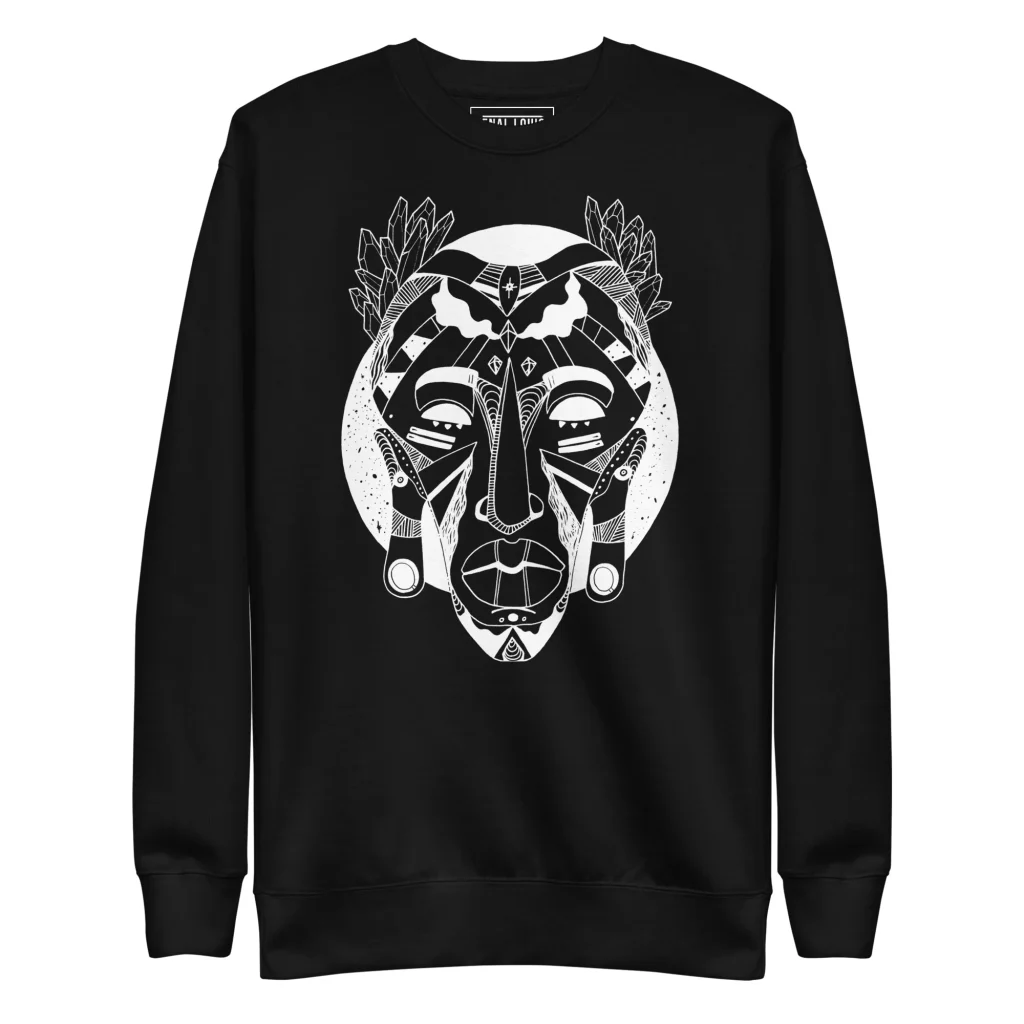
African Mask Sweatshirt - White Line Art Afrocentric Pullover
So my pen and ink mask drawings try to honor each tradition with visual accuracy and cultural respect, not just stylistic approximation. That means studying the ceremonial context, learning the proportional conventions of a given culture, and asking what a particular formal choice — an elongated forehead, a geometric cheekbone, a specific headdress element — was originally meant to express.
Black and White Across the Whole Collection
Every one of these masks is rendered in black and white African mask style using pen and ink. That consistency gives me a collection that honors the diversity of the tradition while speaking in one unified voice. Black and white strips away color as a distraction and forces the viewer to sit with form, line, and geometry — which is exactly where the meaning lives in these faces.
I keep coming back to black and white because what these masks share — form as meaning, geometry as language — matters more than what separates them. The contrast also feels honest to the medium itself. There is nothing standing between the idea and the mark on the page.
What the Variety Means for the Collection
The different masks in my collection are not just visual varieties — each one is a different kind of cultural statement. The tall ceremonial mask with its crystal headdress belongs to the world of the highest-status moments: initiation, funerary practice, the installation of leaders. The broad geometric mask speaks to community ceremonies, where collective identity rather than individual spiritual power was on display. The celestial mask connects to cosmological traditions — the face as a vehicle for cosmic forces rather than specifically ancestral ones.
Understanding those distinctions clarifies why the formal choices differ so much from one piece to the next. The masks look different precisely because they were made for different purposes. The visual language follows the function. A mask meant to embody an ancestor will never look like a mask meant to invoke the sun — and those differences are not accidents. That is the tradition speaking out loud.
My African Mask Canvas Wall Art – Atok and 12 Tribe Chiefs is maybe the clearest expression of all this. It brings together the authority of the ceremonial face mask with a narrative dimension — the idea that a single image can hold an entire community’s history and hierarchy inside it. While I worked on that piece, I kept thinking about how much weight a traditional carver was asked to carry. Every choice had to be right, because the mask would be used in moments that mattered deeply to the people it served.
Because the collection spans so many of these traditions, bringing one of these pieces home means more than choosing a single look. A print like this can become a quiet anchor in a living room, a reminder of heritage in a hallway, or a gift that actually carries weight — something I have seen people give a partner or a parent who has been searching for art that reflects where they come from. It works just as well for someone furnishing a first apartment as it does for someone marking a milestone. That range is one of the most compelling parts of this body of work, and it is why I keep returning to the subject. There is always more to understand, more to draw, more to honor.
Shop at kenallouis.com/ and Support the Culture
My african mask prints are available as fine art prints, canvas wall art, and apparel — all limited edition. Visit kenallouis.com/ and support a Black artist creating for African heritage.
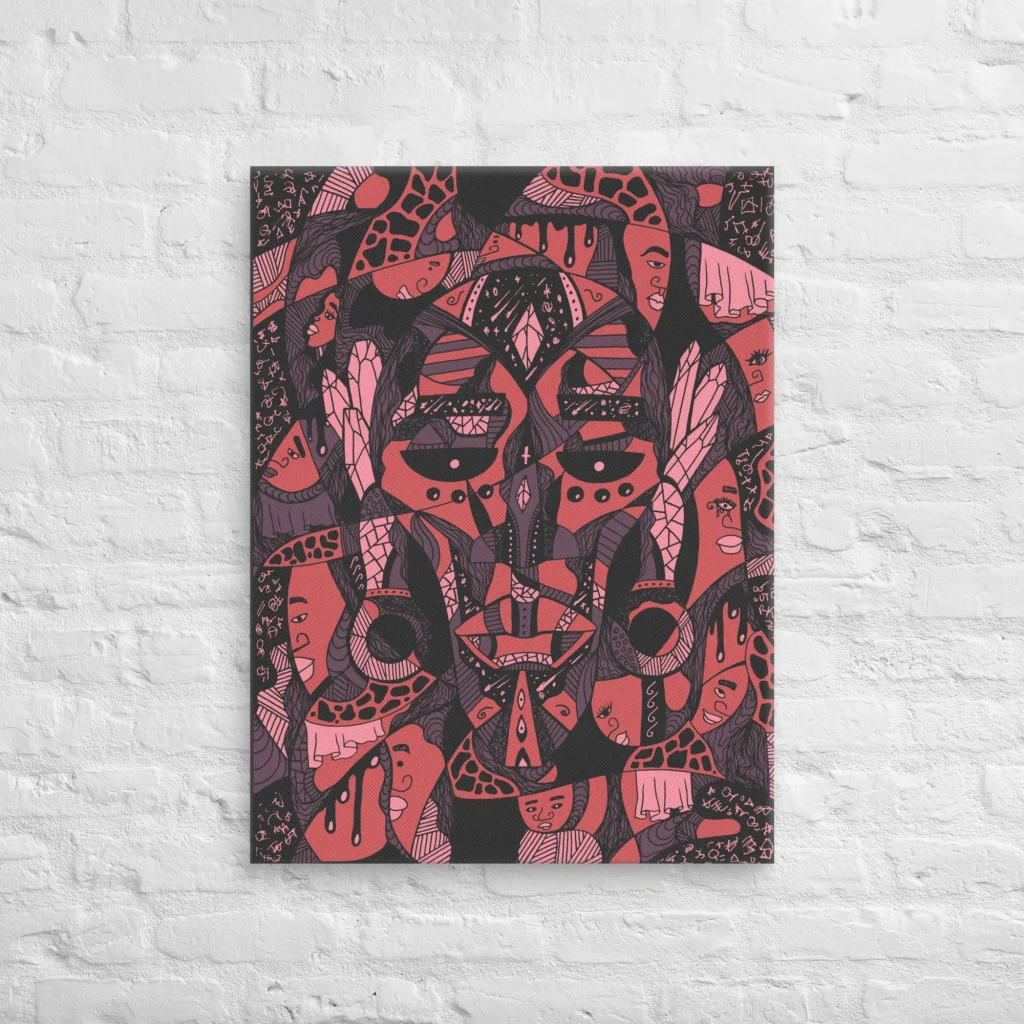
African Mask Canvas Wall Art - Atok and 12 Tribe Chiefs
When I step back from a finished drawing, I am not really looking at lines and ink. I am looking at people who refused to let their stories disappear — who carved their hopes and their dead and their gods into wood so the next generation would remember. If my hand can carry even a fraction of that forward, then the work has done what I asked of it. That, to me, is what beauty leaving a mark really means.