
The Decision to Draw african mask art by Hand
So when people ask me why I do it this way, the honest answer is that there was never really another way for me. To draw african mask imagery — truly draw it, by hand, in pen and ink — was never a casual choice. It came from sitting with the subject long enough to understand what it was asking of me.
I work in pen and ink line art, and I am a Black artist with a deep reverence for where these forms come from. The decision to render mask forms in this specific way grew out of thinking carefully about what the subject actually deserves from the person illustrating it.
Traditional masks were hand-made objects. Every carved groove, every applied surface pattern, every structural decision was made by a person working with physical materials and generations of cultural knowledge. So when I draw African mask art, I wanted to honor that same human-made quality. Nothing generated. Nothing rushed. Just the hand, the pen, and the page.
What Actually Happens When I Draw These Masks
The process is slow by design. I begin with the underlying geometry of the face — the proportions that give a particular mask its identity and its purpose. From there I build the surface patterns one section at a time: crosshatching that creates texture and depth, geometric shapes that carry symbolic meaning, dot work and linear fills that lend the mask its visual density and weight.
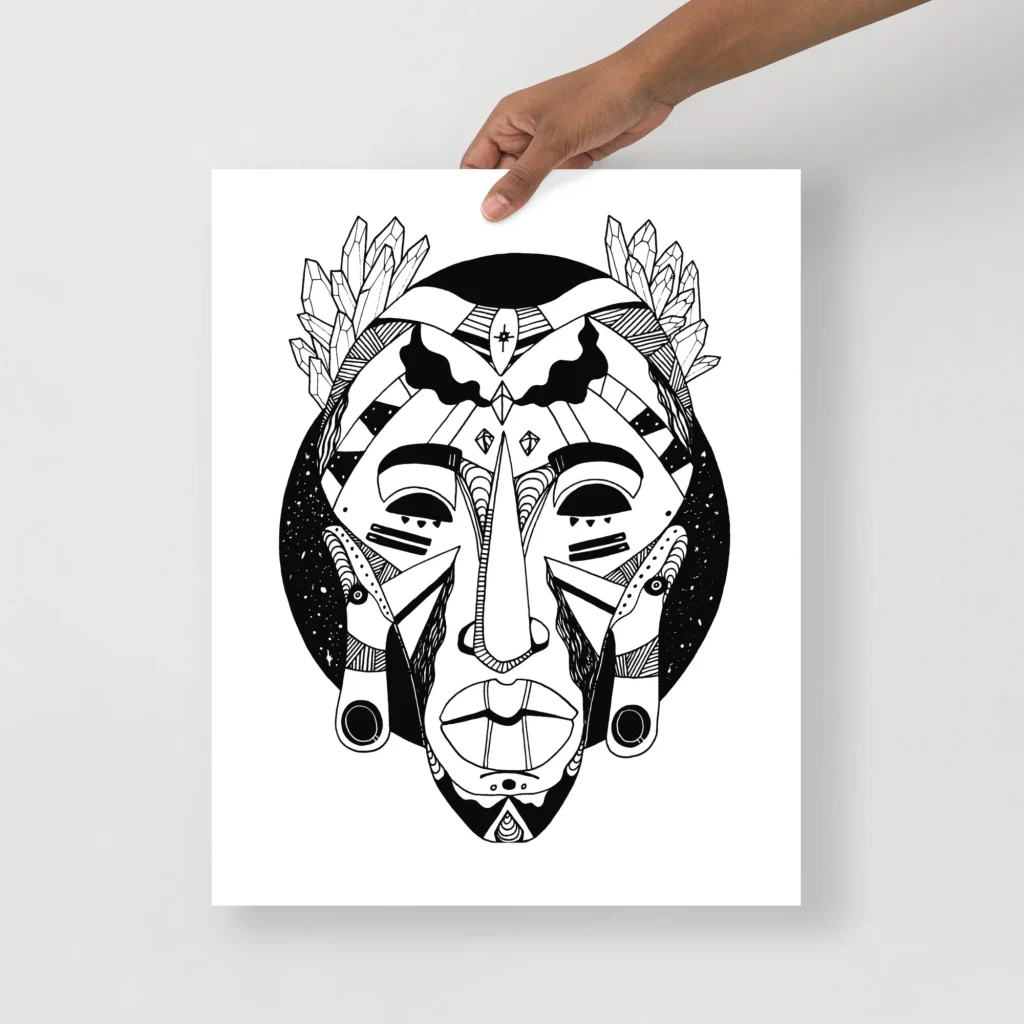
Then come the headdress elements — the crystals, feathers, sun and moon forms that place the mask in a ceremonial and spiritual context. In many of my pieces, the headdress is where the personality of the individual mask truly emerges. You can see this clearly in my African Mask Art Print – Tribal Pen ink drawing, where the headdress rises into an elaborate crown of layered geometric forms, each one drawn line by line with no shortcuts whatsoever.
This commitment to stunning African art in bold black and white extends to every compositional choice, including setting everything against a black circular background scattered with suggestions of stars. That choice came from thinking about where these masks originally lived — not in galleries, but in ceremony, in firelight, against the night sky. The starry backdrop honors that original context.
Why Pen and Ink Is the Right Tool
There are faster ways to draw African mask art. Digital tools. Color illustrations. AI-assisted generation. I chose not to use any of them — because the value of this work lives precisely in the slowness. In the visible evidence of the hand. Every line in a piece like my African Mask Art Print No. 3 – Tribal Wall Art was placed deliberately, one stroke at a time, building up the surface until the mask feels like it carries real weight and presence on the page.

When I work in pen and ink, the time I spend with the subject stays present in the finished piece. You feel it in the density of the patterns. In the confidence of the lines. In the way each piece feels like it cost something to make — because it did. That quality simply cannot be replicated by a faster process, and I have no interest in pretending otherwise.
Black and White Is Non-Negotiable
I also made the deliberate choice to work exclusively in black and white, because it aligns with what the mask form is actually asking for. Masks communicate through symbol and geometry, not color. Stripping away color lets those structural and symbolic elements speak directly, without distraction. The contrast between the dense ink work and the white of the paper creates a visual tension that feels right for this subject — stark, ceremonial, and precise.
Truly, what African masks in art mean to me is reflected in every piece I make in this format. The finished work feels connected to something ancient, because in the ways that matter most, it is.
The Specific Details I Focus on Most
Certain details receive particular attention because they carry the most visual and cultural weight. The eyes are one of these. In the tradition I draw from, eyes are often rendered to signal the kind of vision a mask embodies — wide and open to suggest expanded awareness, heavily lidded to suggest inward sight, geometric in form to suggest a vision that is not simply human. I think carefully about the eyes every single time, because they are often the first place a viewer’s gaze lands and the last detail they remember.
The nose and lips are another area of deep focus. These features tend to be simplified and strengthened — not because detail is impossible, but because the exaggeration itself carries meaning. A bold, prominent nose signals heightened spiritual awareness. Strong, full lips signal vocal power in ceremony. As I draw African mask features, I try to carry these intentions directly into my pen and ink line choices, letting the weight of the stroke reflect the weight of the meaning behind it.
The surface patterning that fills each plane of the mask is just as deliberate. Rather than filling space for the sake of busyness, I think about what each pattern zone is doing — whether it is grounding the mask, elevating it, or marking a boundary between the human and the spiritual. That attention to the meaning behind formal choices is what separates a thoughtful piece from a merely decorative one.
Own Art That Was Made This Way
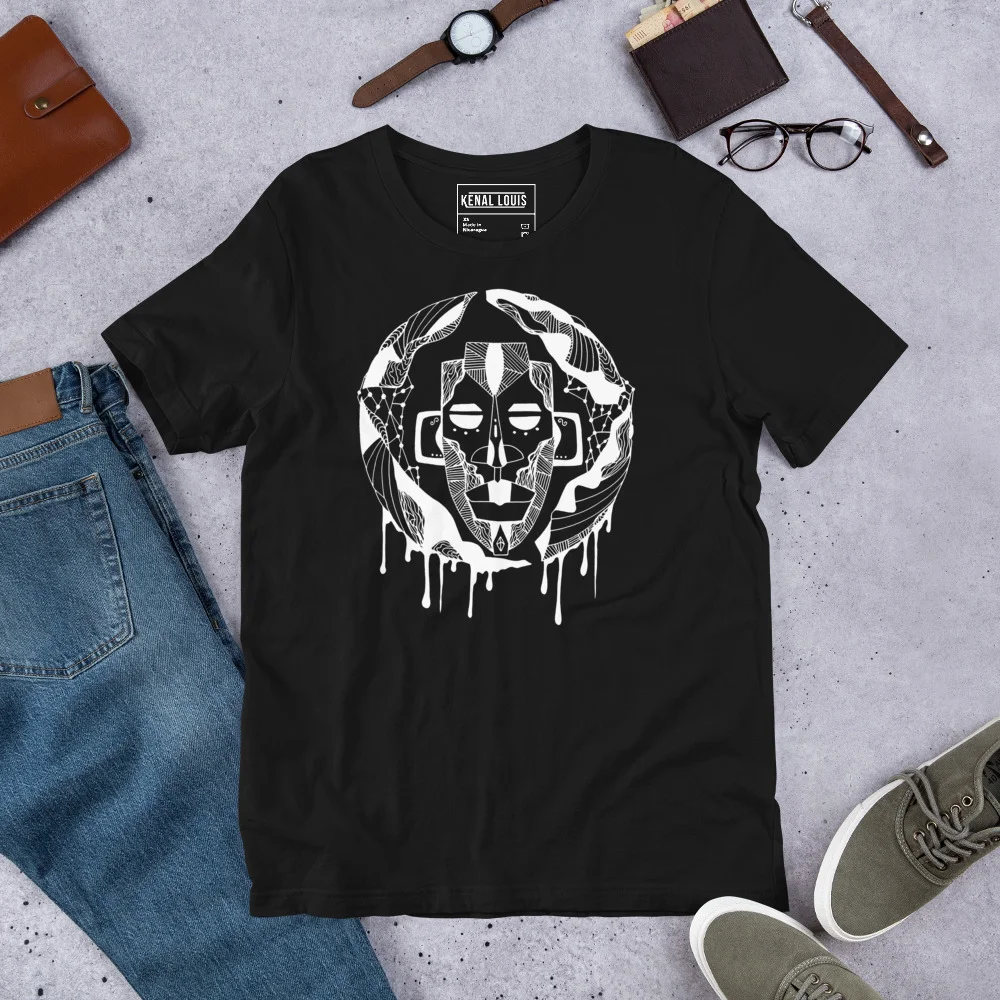
My mask prints are available as fine art prints, canvas wall art, and apparel. Every edition is limited — once a run is gone, it is gone. The African Mask T-Shirt – Mask Drip White Line Art Tee brings this same hand-drawn pen and ink energy into wearable form, with white line work on a dark ground that carries the same ceremonial weight as the fine art prints.
If you are choosing one of these for someone you love, that is the part that means the most to me. A piece like this lands beautifully with someone who carries their heritage close — a sister who has always been drawn to bold, meaningful imagery, a friend marking a new home, a parent who taught you where you come from. It works for a birthday, a graduation, or simply a quiet moment when you want to tell someone you see them. The work was made slowly, by hand, so it tends to be received the same way — with attention.
Buy Art That Supports African Heritage
Visit kenallouis.com/ and explore the collection. Every purchase supports a Black artist making original, hand-drawn work in honor of African culture. No AI involved. No shortcuts. Just the pen, the page, and everything the hand can say when it slows down long enough to mean it.