
African Mask Design as a Visual Language
When I started this series, I kept circling back to one question: how do you honor a ceremonial object on a flat sheet of paper without flattening its meaning too? That question shapes everything I do here, because african mask design is never arbitrary — and understanding that truth is the foundation of the work.
When I sit down to create an African mask design in pen and ink, I am not choosing shapes because they happen to look interesting. I am making decisions rooted in mask tradition — what specific proportions communicate, what certain patterns mean, what the placement of headdress elements signals within the ceremonial context the mask was originally made for.
That understanding is what separates a respectful piece from a merely decorative one. It is the difference between borrowing a visual style and genuinely engaging with a visual language that carried weight long before I ever picked up a pen.
The Core Elements That Hold the Face Together
A strong mask is built from several core elements that work together to create its visual character and communicative power. Each element carries weight — none of it is filler, and none of it is there by accident.
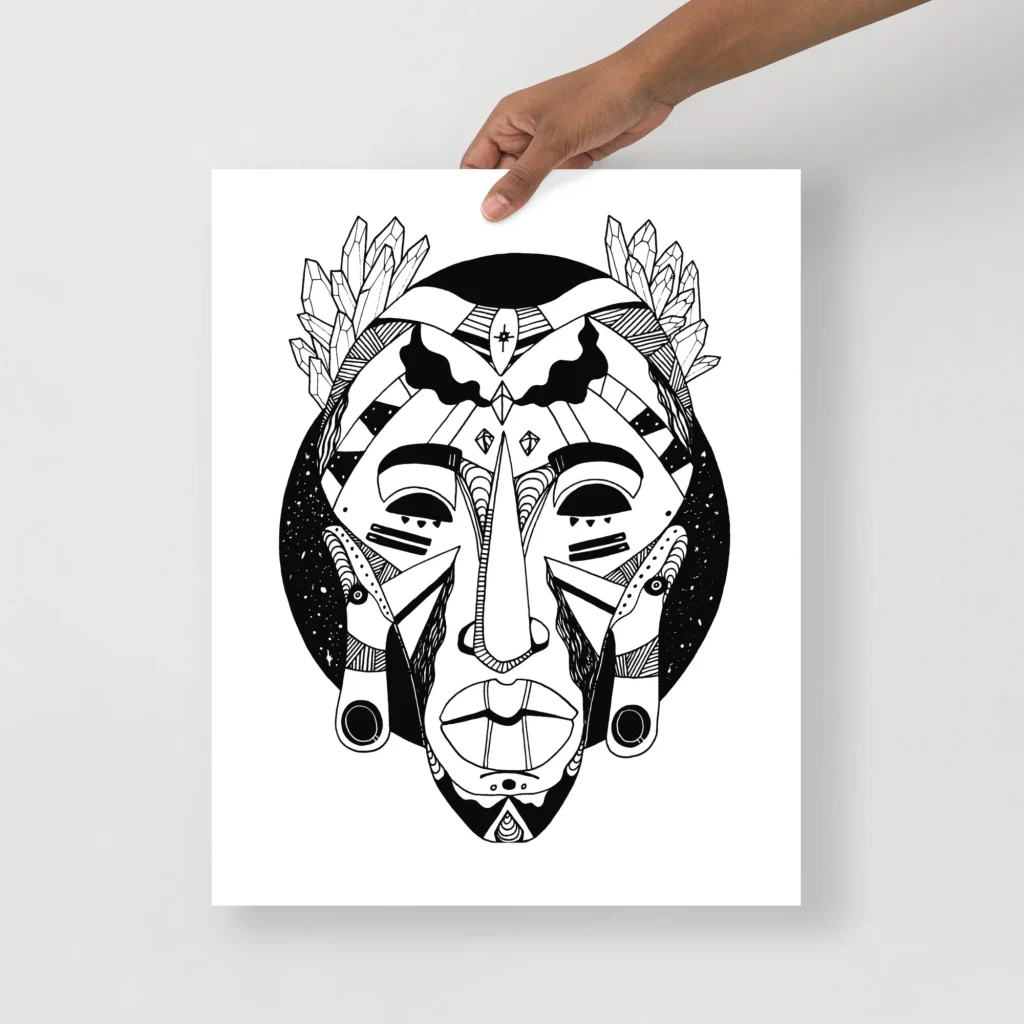
Proportion is the foundation. Traditional masks lean on exaggerated proportions to signal spiritual rather than naturalistic identity — a wide forehead suggests wisdom and vision, elongated features suggest connection to the ancestral realm, and bold facial structure signals authority and ceremonial power. I lean into these proportions deliberately in every piece, letting the face read as something beyond the everyday.
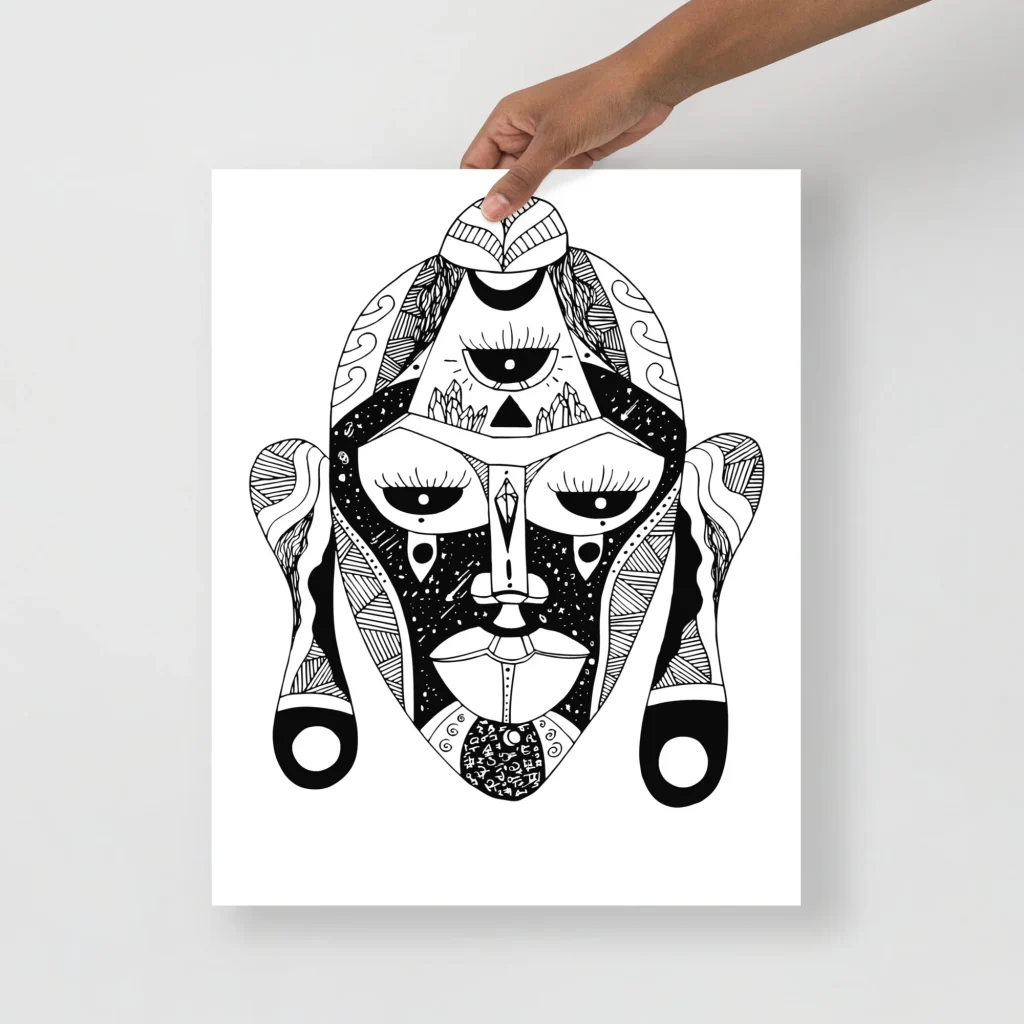
Surface patterning is the second layer. The patterns that fill the face are not mere decoration. They carry information — about types of African masks, their cultural origins, ceremonial functions, and identity within the community’s visual vocabulary. In my ink work, I fill every surface plane with intention: interlocking lines, crosshatched fields, and radiating forms that give each region of the face its own texture and meaning.
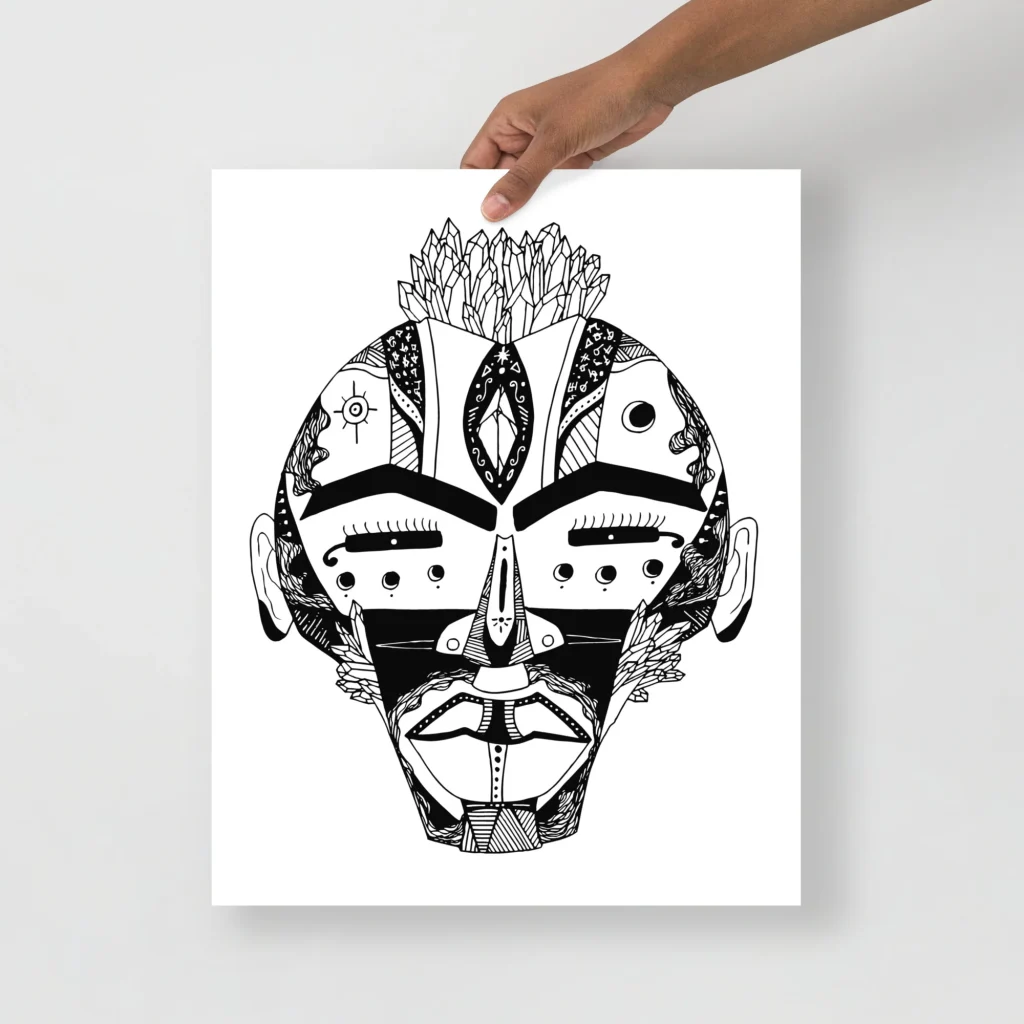
The headdress is the third major element. So much visual energy lives in the headdress — the crown, the feathers, the architectural forms that rise above the face. These elements signal the spiritual identity of the force the mask represents. In my pieces, I build crystal formations, feather forms, and celestial symbols into headdresses that carry that same ceremonial authority in ink on paper.
Why Pen and Ink Serves This Subject So Well
I reach for African art created with pen and ink because the medium forces clarity. In black and white, with no color to lean on, every choice has to be made with full intentionality. The line either earns its place or it does not. There is nowhere to hide a weak decision behind a wash of color or a soft gradient — the structure of the drawing has to hold on its own two feet.
That demand aligns perfectly with what these masks are actually doing. Every element in a traditional mask is placed for a reason. The medium and the subject share the same discipline, and that overlap is part of what keeps me coming back to it.
Black and White Is the Right Choice
I also chose black and white African mask art because it respects the formal logic of the form. These masks communicate through geometry — through the relationship between shapes, the rhythm of repeated patterns, the contrast between filled and open areas. Color would add noise to that conversation. Black and white lets the structure speak without interruption.
An African mask design rendered in pen and ink is, to my mind, the most honest format for this work. It strips the image down to its essential architecture and then lets that architecture carry everything.
How the Mask Becomes Wall Art
The translation from ceremonial principle to wall art is something I think about carefully with each piece in this collection. The original mask was a three-dimensional object experienced in ceremony, in movement, in firelight. A pen and ink illustration is a flat image experienced in stillness, on a wall, in ordinary daylight. Those are very different conditions, and bridging them takes deliberate compositional choices.
The challenge is to capture the energy and presence of the original object in a two-dimensional format. My approach is to use bold proportions, dense geometric fills, and strong contrast to create a sense of visual weight — the same qualities that made the original objects powerful in their ceremonial settings. When the drawing is working, you should feel the mask looking back at you from the wall the way it once commanded attention in a ritual space. That presence is also why this work resonates as a meaningful gift — I have had people give these prints to a father reconnecting with his roots, to a friend furnishing a first apartment, to a graduate stepping into a new chapter — moments when you want a piece that says something rather than just fills a space.
The circular black backdrop that appears in many of these pieces is a key part of that effort. It creates a sense of depth that the flat paper alone could not achieve. The face emerges from the dark circle the way a ceremonial mask would emerge from the darkness of the forest, the night, the ritual ground. Every compositional choice in this body of work — the backdrop, the proportions, the density of the patterning — serves the goal of building a two-dimensional equivalent of the original object’s ceremonial power. That is the design problem that keeps this work genuinely interesting to me, and one I return to with every new drawing.
Own a Print of This African Mask Design Work
My prints are available as fine art prints, canvas wall art, and apparel. All editions are limited, so shop now before they are gone.
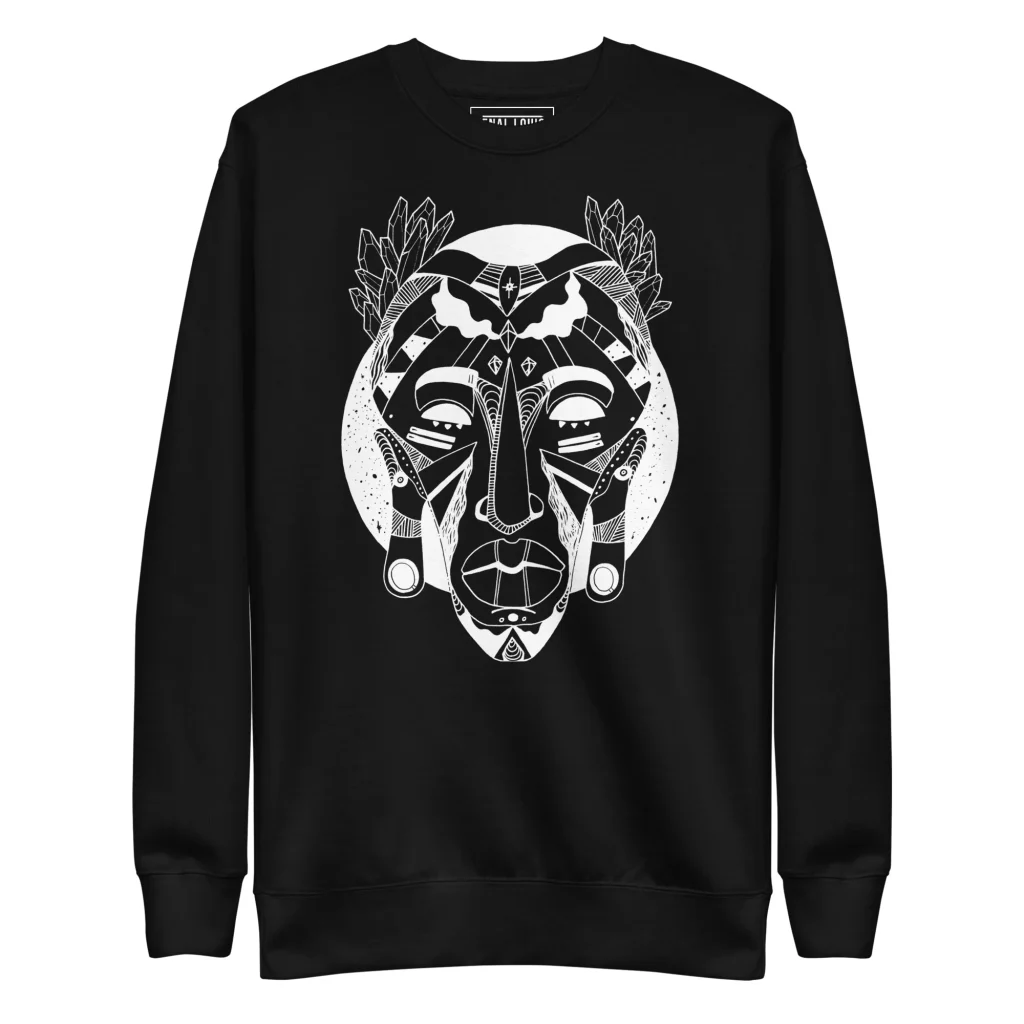
African Mask Sweatshirt - White Line Art Afrocentric Pullover
Support African Heritage Through Original Art
Visit kenallouis.com/ and find the piece that belongs on your wall. Every purchase supports a Black artist making original work in honor of African culture.
And that brings me back to where I began — that quiet question about honoring a ceremonial object on flat paper. The answer, I have learned, is to draw it like it is still looking back at you. When the mask holds your gaze from the wall, the language has survived the translation.