
What It Means to african mask Draw by Hand
There is a particular feeling these drawings are meant to give the person who lives with them — a sense of standing in front of something patient, ancient, and quietly powerful. To african mask draw by hand, with my full attention given to every line, is one of the most demanding and rewarding things I do as an artist.
I am Kenal Louis, and I have been drawing african mask imagery in pen and ink for years now. Every time I sit down with a fresh sheet, the same thing happens. The world outside gets quiet. The noise fades. The only things left are the pen in my hand and the face slowly rising up beneath it.
So why this way? Why choose to draw African masks line by line instead of going digital, or adding color, or rushing the whole thing through some faster process? Let me walk you through it.
The Case for Drawing by Hand
When I draw African masks in pen and ink, I am choosing slowness on purpose. The traditional mask — carved, sculpted, or woven — was always made with patience and precision. The maker’s full attention lived inside every cut, every notch, every geometric pattern set carefully into the surface. None of it was hurried.
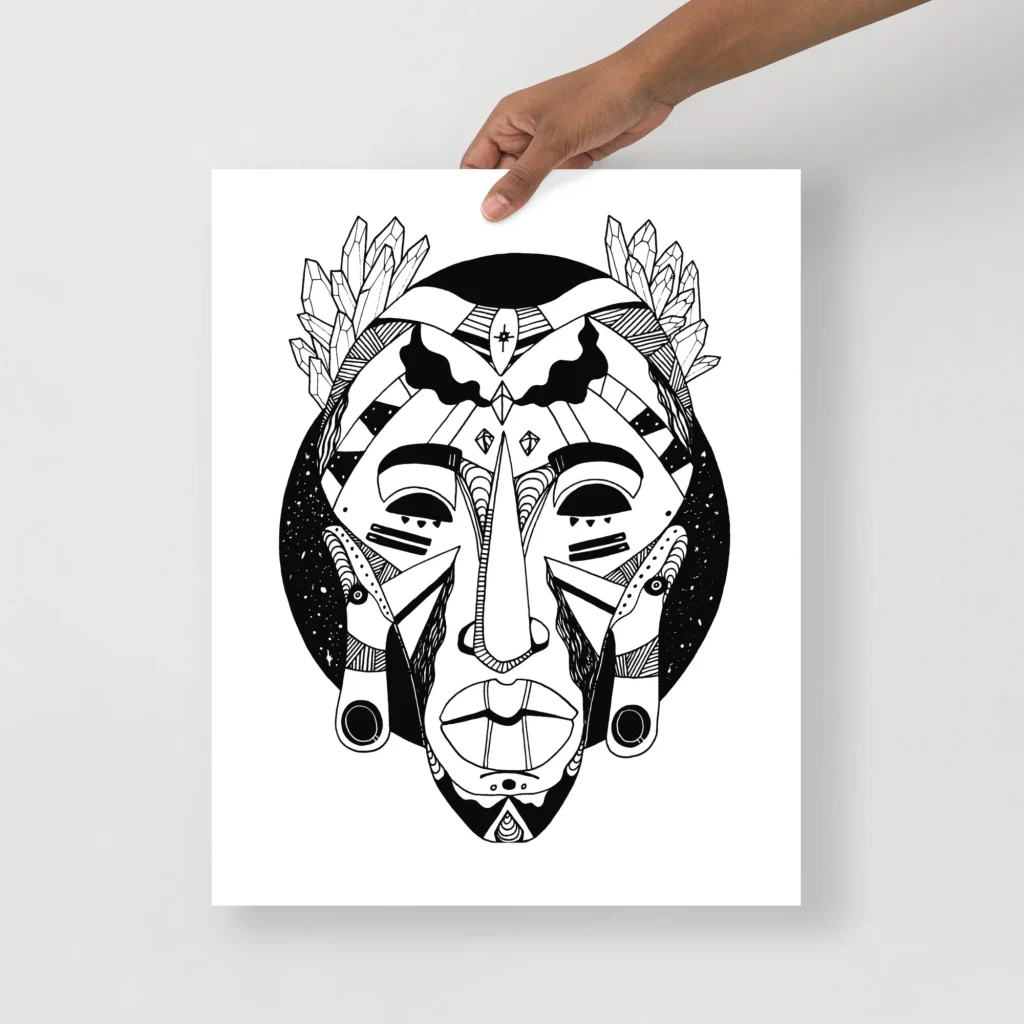
So when I commit to making these masks entirely by hand, I am trying to honor that same bond between maker and material. That bond is part of why African masks in art matter so deeply to me as a Black artist. I am not handing the thinking over to a machine. I am sitting with the subject, studying it, and letting it teach me something about itself while I draw.
There is also something that lives in African mask design drawn with the human hand that digital marks simply cannot fake. The slight shift in pressure. The way the ink blooms at the tail end of a stroke. The tiny tremor of a line pulled across the page. Those small imperfections are the proof that a real person made this — and in a subject as historically heavy and meaningful as the african mask, that proof matters more than you might think.
What My african mask drawing Process Actually Looks Like
I begin with the overall structure of the face. The proportions of these masks are never naturalistic — they are expressive. A broad forehead. Eyes placed with intention. A nose and mouth whose specific forms carry cultural meaning rather than realism. Getting that foundation right is everything.
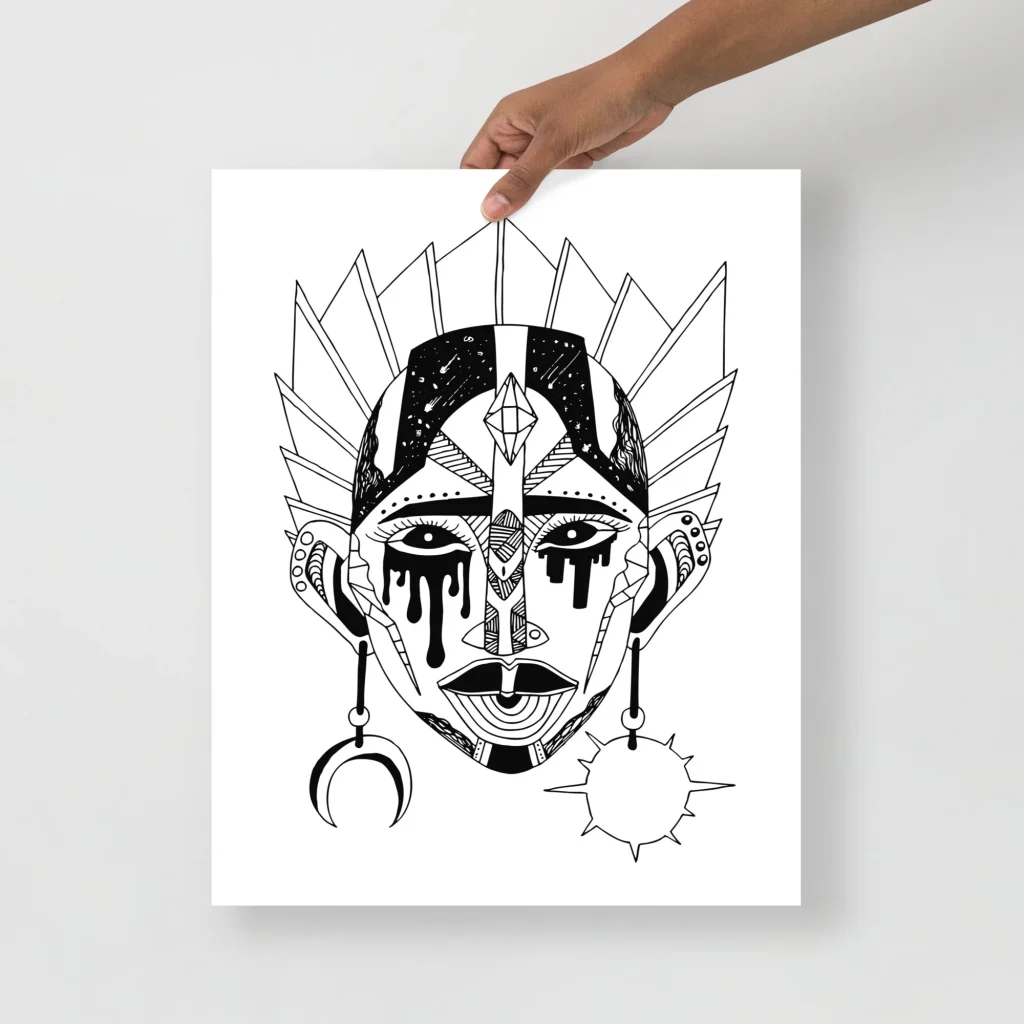
Then I move into the surface patterns, and this is where the work becomes its own kind of meditation. Geometric fills, crosshatch textures, dot work, interlocking shapes — each one builds the visual density that gives black and white African mask art its commanding presence. In a piece like African Mask Art Print No. 12 Tribal Wall Artwork, you can watch those layered patterns stack up into something that feels both ancient and completely alive in the present moment.
Last comes the headdress. Crystals, feathers, rays of light reaching outward. These are the elements that lift the mask into a ceremonial and spiritual register — past the ordinary human face and into something that speaks to ancestry, ritual, and inherited power.
Black and White Is the Only Choice
I never add color to these drawings, and that choice is a philosophical one, not a practical one. African art in bold black and white keeps the work essential instead of merely decorative.
In black and white, the patterns carry the load that color would otherwise steal. The intricate geometry, the stark contrast between filled and open spaces, the weight of solid black pressing against fine linework — all of that becomes the full visual language of the piece. The patterns have earned that room to breathe, and color would only crowd them out and dilute their voice.
The Tools and Materials Behind Each Drawing
When I draw these masks, I work with a fine-point technical pen and high-quality illustration paper. The pen itself matters enormously. I need a tool that lays down consistent, precise line weight for the geometric fills, yet still lets me lean in with heavier pressure for the bold outlines that anchor the whole composition. I have spent years quietly refining what I reach for, and not one of those choices is accidental.
Each session is methodical. I set the proportions of the face first, drawing lightly until the structure feels right. Only then do I commit to the permanent linework — starting with the major outlines, then adding the surface patterns section by section, moving across the face the way a sculptor might travel around a form, never skipping ahead.
The circular black backdrop that shows up in so many of these pieces — most visibly in African Mask Canvas Wall Art – Atok and 12 Tribe Chiefs — asks for a particular kind of patience. I flood the background with solid black ink, working carefully around every star mark and the outer edges of the headdress. It is slow, exacting, unforgiving work. But when the deep black is finally complete and the mask face stands glowing against it, it is worth every single minute. That contrast — the luminous face emerging out of darkness — is one of the most powerful choices in the entire series, and it only exists because every inch of that black was laid down by hand.
Own a Print Made Through This Process
My African mask prints are available as fine art paper prints, canvas wall art, and apparel. The editions are limited, so if one of these pieces locks eyes with you, I would not wait on it.
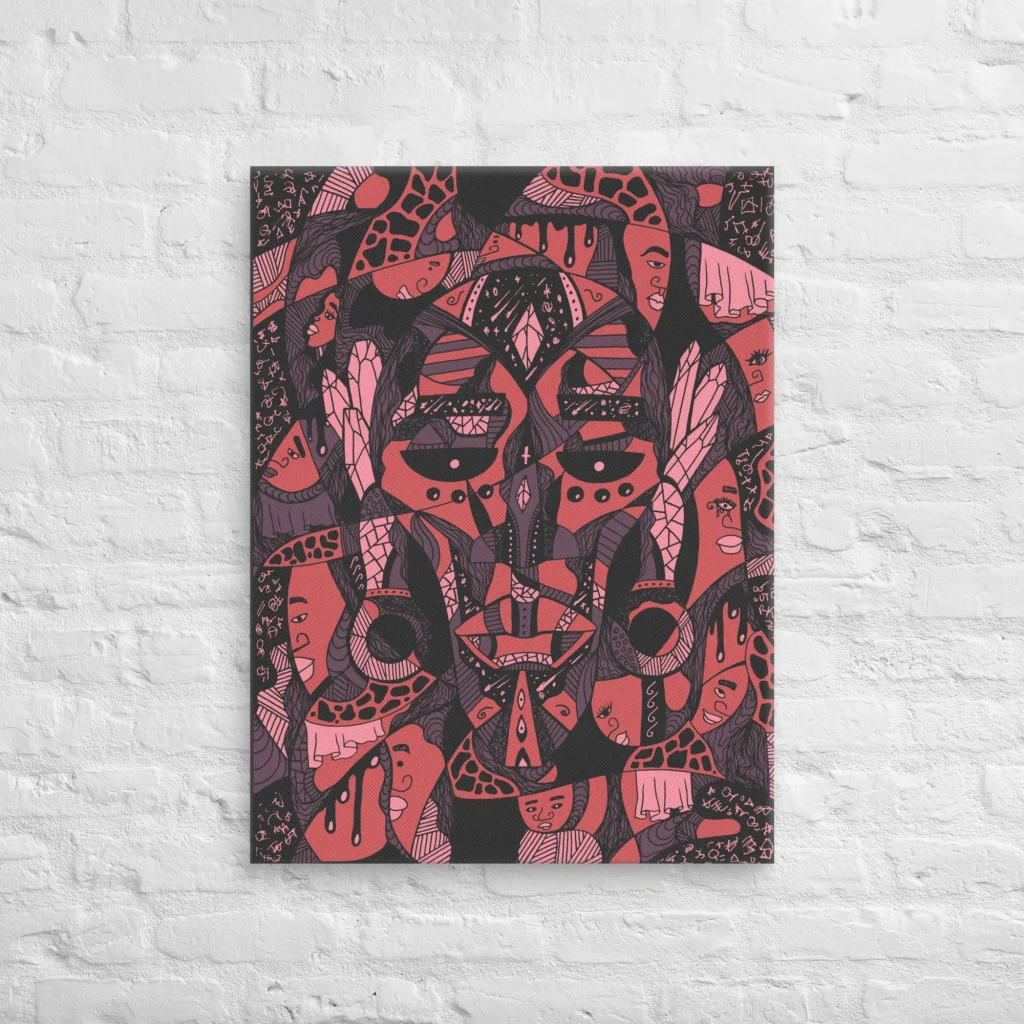
African Mask Canvas Wall Art - Atok and 12 Tribe Chiefs
Support Black Art and African Heritage
If you are searching for something with real soul for someone you love — a best friend who appreciates handmade work, a family member honoring their roots, a partner whose walls deserve something with weight — these pieces were made for moments like that. Visit kenallouis.com/ and find the one that belongs on your wall, or theirs. This is original, human-made art created in honor of African culture and history, and every purchase directly supports an artist making this work for the culture, one careful pen stroke at a time.