
Drawing African Masks as a Practice, Not Just a Product
I still remember the first night I tried to fill an entire mask face with hatching by the dim lamp at my desk. My hand cramped, my coffee went cold, and somewhere around the fourth hour the form finally clicked. That moment never quite leaves me. Drawing African masks is not something I approach casually — it is a practice, a recurring discipline that deepens with every piece I create.
Each time I sit down to begin drawing African masks in pen and ink, I am entering a subject that has more layers than any single illustration can fully capture. But I try anyway. And with every attempt, something new comes through — some detail of the visual tradition I had not fully understood before, some quality of the mask form that only reveals itself in the act of putting line to paper.
The Specific Challenges I Face With This Subject
This subject presents challenges that other portrait work does not. The proportions are deliberately non-naturalistic. The mask maker exaggerated certain features for expressive and ceremonial reasons, so I have to understand those reasons before I can make faithful choices about scale and proportion. There is no shortcut around that homework.
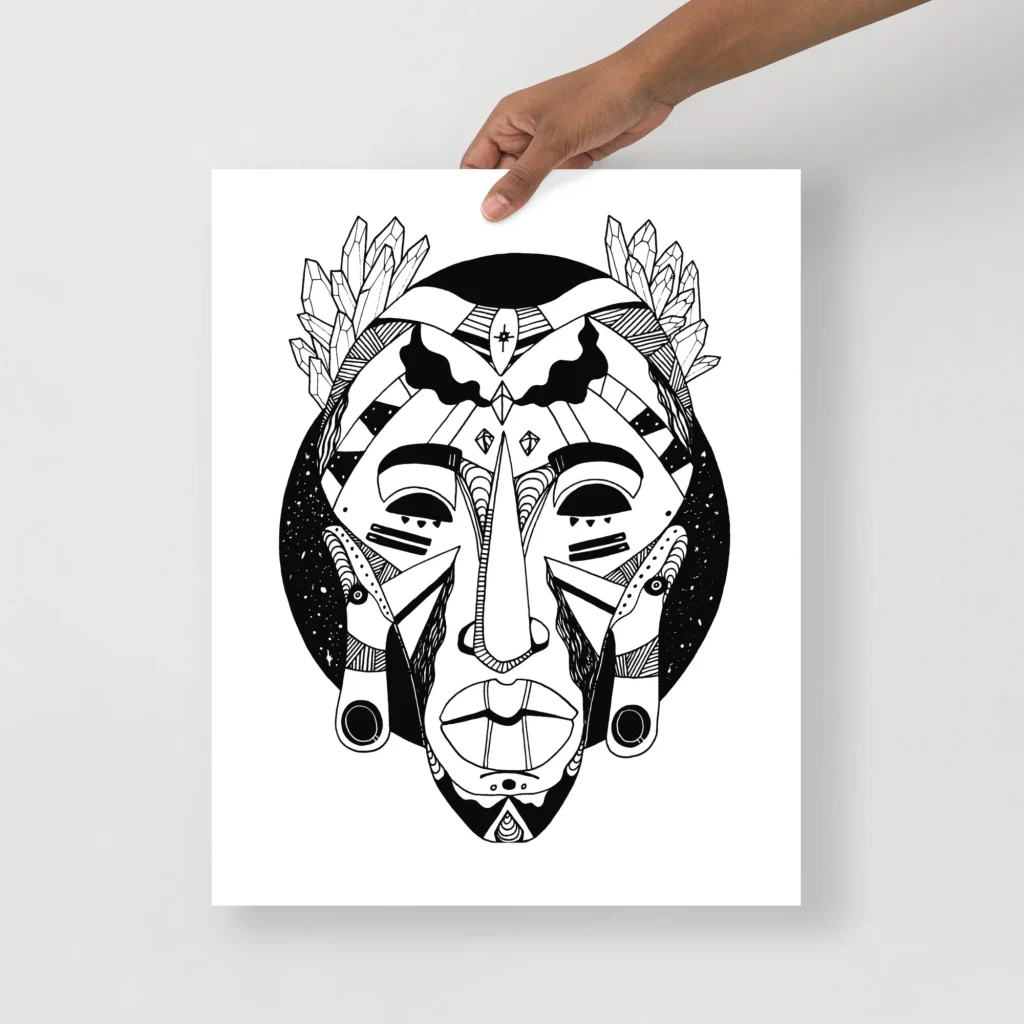
The surface patterns are another level of challenge entirely. Doing this well means filling every plane of the face with geometric patterns that feel coherent, intentional, and visually dense without tipping over into chaos. That takes time and real discipline. A single african mask drawing can demand many hours of concentrated linework — and that time is never wasted, because it is in those hours that the drawing starts to breathe.
Then there is the headdress. The ceremonial elements, the layered forms, the symbolic details that place the face in a spiritual and cultural context — these carry as much meaning as the face itself. Rushing them leaves the work feeling incomplete and unrooted, like a sentence with the ending cut off.
What This Practice Has Taught Me
The act of drawing African masks has taught me things I could not have learned any other way. It has shown me the relationship between form and meaning in African visual cultures — the specific geometries that different traditions use to express specific ideas, and the way a well-made mask communicates before the conscious mind has time to analyze it. There is an immediacy to these forms that I find endlessly compelling, and chasing that immediacy in pen and ink keeps pushing my draftsmanship forward.
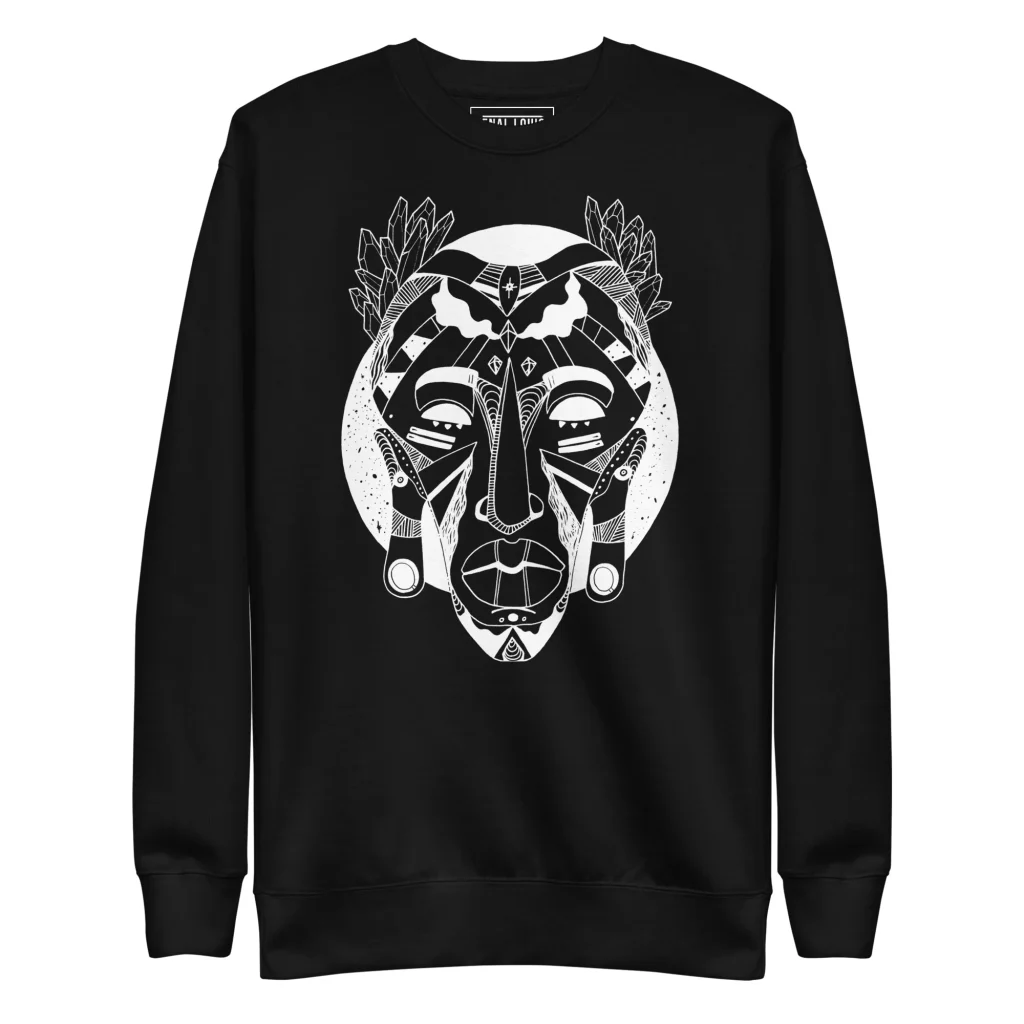
African Mask Sweatshirt - White Line Art Afrocentric Pullover
All of that understanding feeds straight back into the work, making each piece in the series more grounded and more deliberate than the last. I am not simply copying a shape. I am trying to understand why the shape exists, and then letting that understanding guide every line I lay down.
Why Black and White Serves This Subject Best
When I sit with this subject, I always work in black and white African mask designs. That decision comes from a deep belief that color would pull the work toward decoration rather than cultural expression. Stripped to ink, the piece becomes an exercise in essence — just the form, just the symbol, just the line. White lines carving through dark space, or dense ink hatching building a face up from nothing, force both me and the viewer to sit with the structure of the mask itself instead of being carried off by color. That restraint is intentional, and I think it is what gives these pieces their weight.
Truly, that is where the power lives.
The Ongoing Nature of This Work
This is not a project I have finished. It is a practice I have returned to again and again over the years, and one I will keep returning to. Each new piece in the series builds on what the previous ones taught me. Every fresh session reveals something I had not fully understood before — whether that is the way a particular culture uses symmetry to suggest spiritual balance, or the way a single headdress element transforms the entire emotional register of a face.
That ongoing engagement is, I believe, the right relationship to have with this subject. African mask traditions are not a fixed archive. They are living visual cultures that have continued to develop and evolve across generations and communities. Committing to drawing African masks with that same ongoing devotion honors that living quality rather than treating the tradition as a closed set of forms to be catalogued once and set aside.
The practice also keeps me humble about what I know and what I do not. The more faces I draw, the more aware I become of the vast range of forms, traditions, and regional histories I have not yet touched. This collection is not a final statement. It is an ongoing conversation between my pen and ink and a tradition that deserves continuous, serious artistic attention.
Own Prints from This Practice
My african mask prints are available as fine art prints, canvas wall art, and apparel. Every run is limited — once an edition is gone, it does not come back. A bold ink piece like this makes a meaningful gift too, especially for someone reconnecting with heritage. I have shipped these to a brother celebrating a milestone, to friends settling into a first home, and to people who simply wanted something powerful staring back at them across a room.
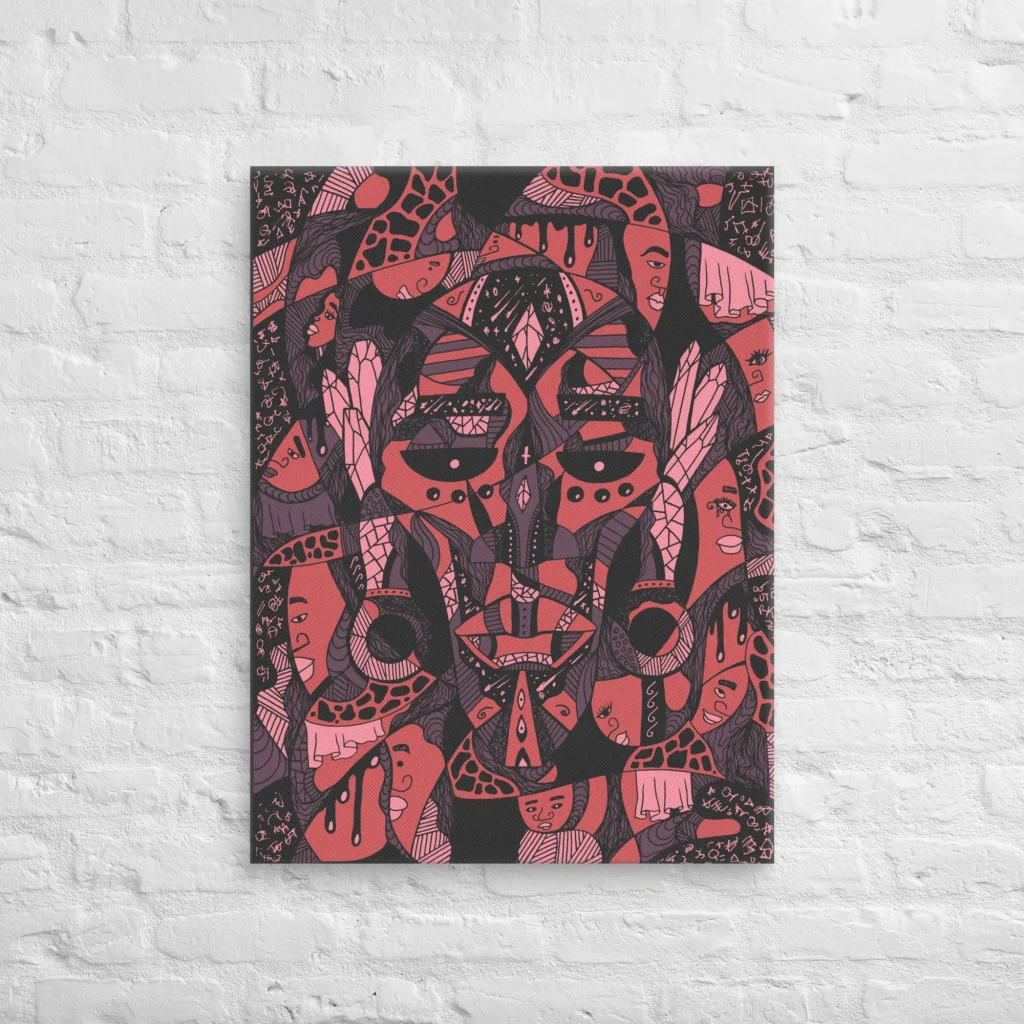
African Mask Canvas Wall Art - Atok and 12 Tribe Chiefs
Support a Black Artist Drawing for the Culture
Visit kenallouis.com/ and find the piece that belongs on your wall. Every purchase supports original, hand-drawn African heritage art made by a Black artist creating for the culture.
I hope that when one of these masks hangs in your space, it does what it has always done for me — it holds the room with a quiet, ancestral steadiness, and reminds you that there is depth and meaning in the forms we carry forward.