A Heart Line Drawing That Says Everything in the Stroke
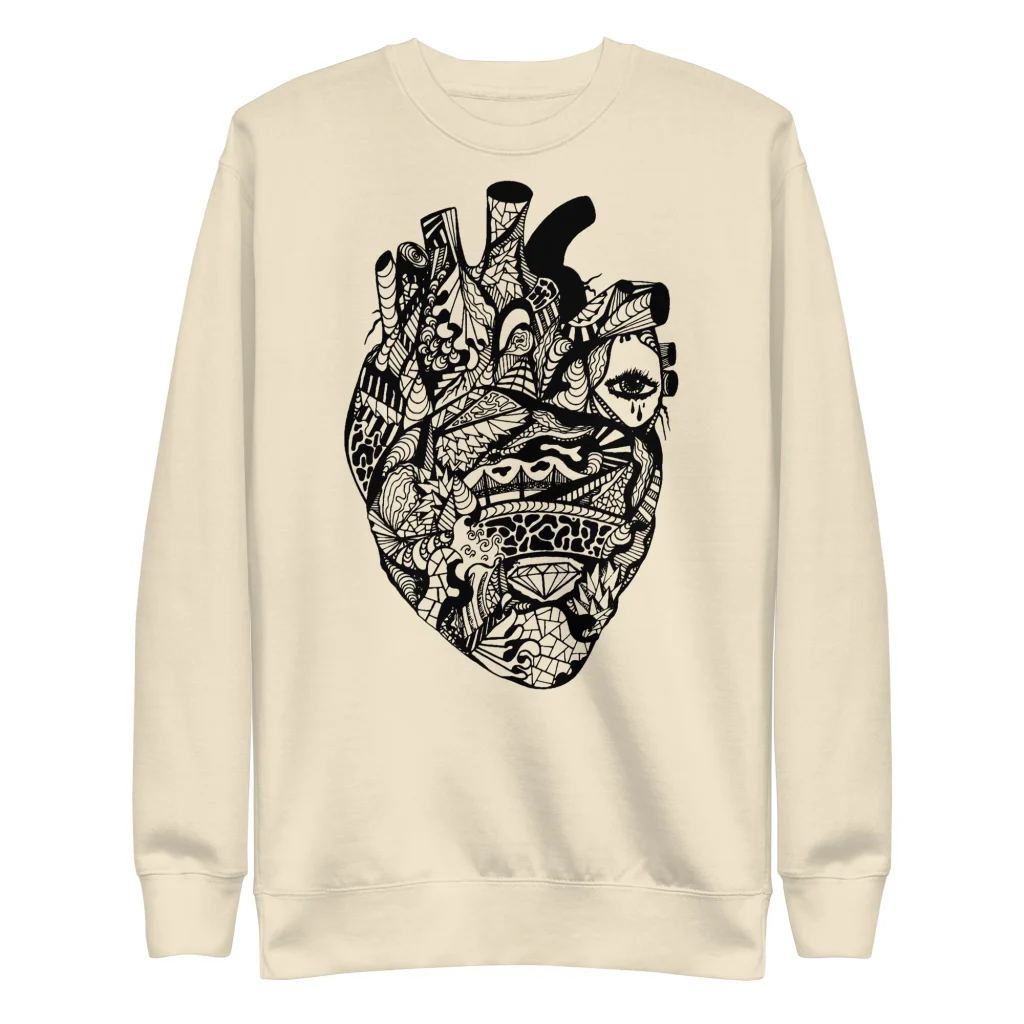
…and that is really the whole challenge, isn’t it? When I sit down to make a heart line drawing, there is no color to fall back on, no shading to soften a clumsy choice. The line has to carry everything by itself. It is one of the most fundamental acts in drawing, and somehow one of the most demanding, because every bit of weight that color and tone would normally share now rests on a single mark.
My work here is pen and ink — black and white, hand-drawn, start to finish. The approach I bring to it grows out of one belief I keep returning to: a line should only exist on the page if it earns its place. Nothing is decoration for its own sake. Every stroke is deliberate, and every mark contributes something that would genuinely be missed if I left it out. That standard makes the drawing slower, but it also makes it honest.
What comes out of that process is a style that is precise and organic at the same time. The lines describing the anatomical form of the heart stay clean and structural, while the lines building the interior world flow freely, full of movement and breath. The two qualities live side by side, and the tension between them is where the piece comes alive.
Two Types of Line Working Against Each Other
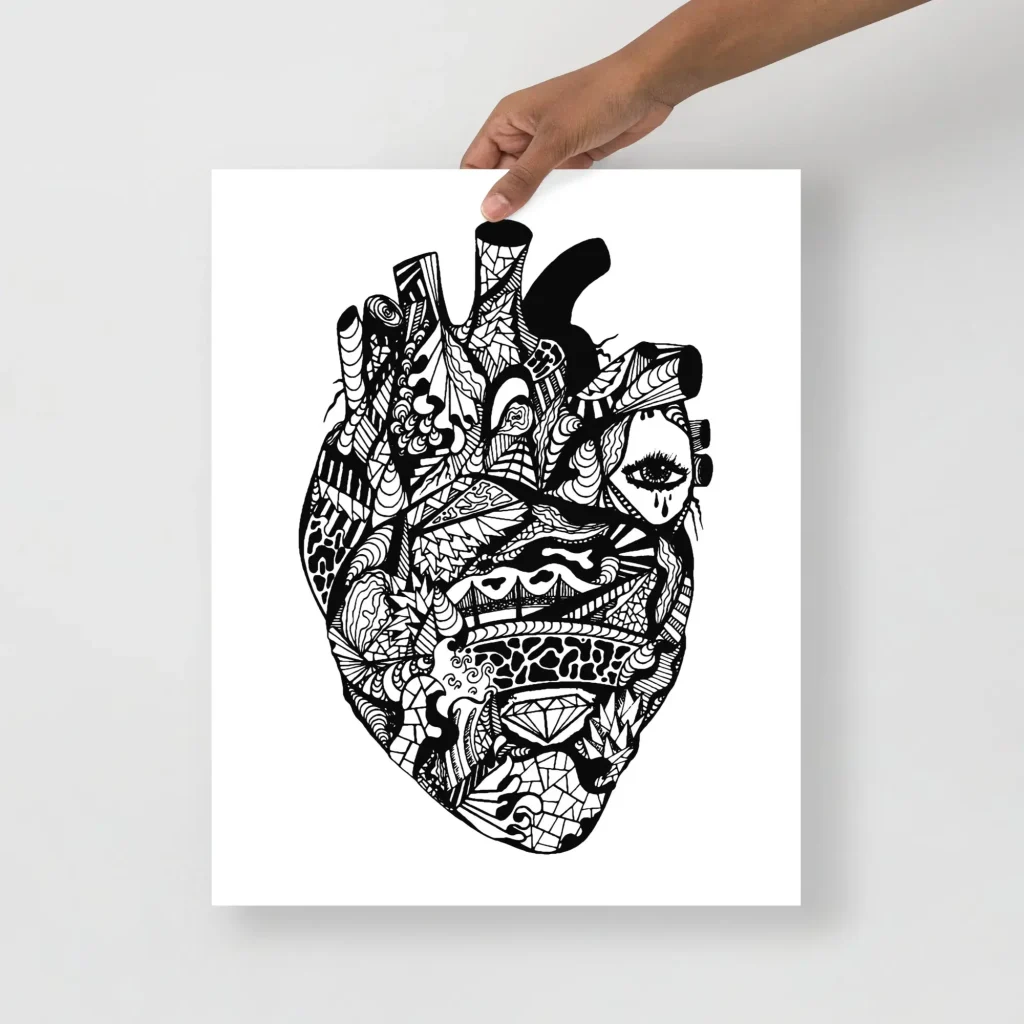
There are really two distinct kinds of linework in these pieces, and the contrast between them is a big part of what gives the images their energy.
The first is the structural line — the heart drawing anatomy defined by bold, confident strokes that establish the exterior form. The aorta. The chambers. The vessels branching outward from the upper surface. These lines are direct and decisive. They build the container — the recognizable silhouette of a real human heart, rendered with care and anatomical intention rather than guesswork.
The second kind is the interior work: the flowing, organic, densely layered marks that fill the world inside the form. These lines curve and coil and pour into one another. They create surfaces that seem to ripple and shift. They grow into botanical shapes and waves. They form an eye nestled in a lower chamber, complete with lashes and a single suspended tear. They suggest the dark interior field of something enormous and alive. This is where the drawing breathes — where the emotional weight settles, and where your eye can wander and keep discovering things you missed the first time.
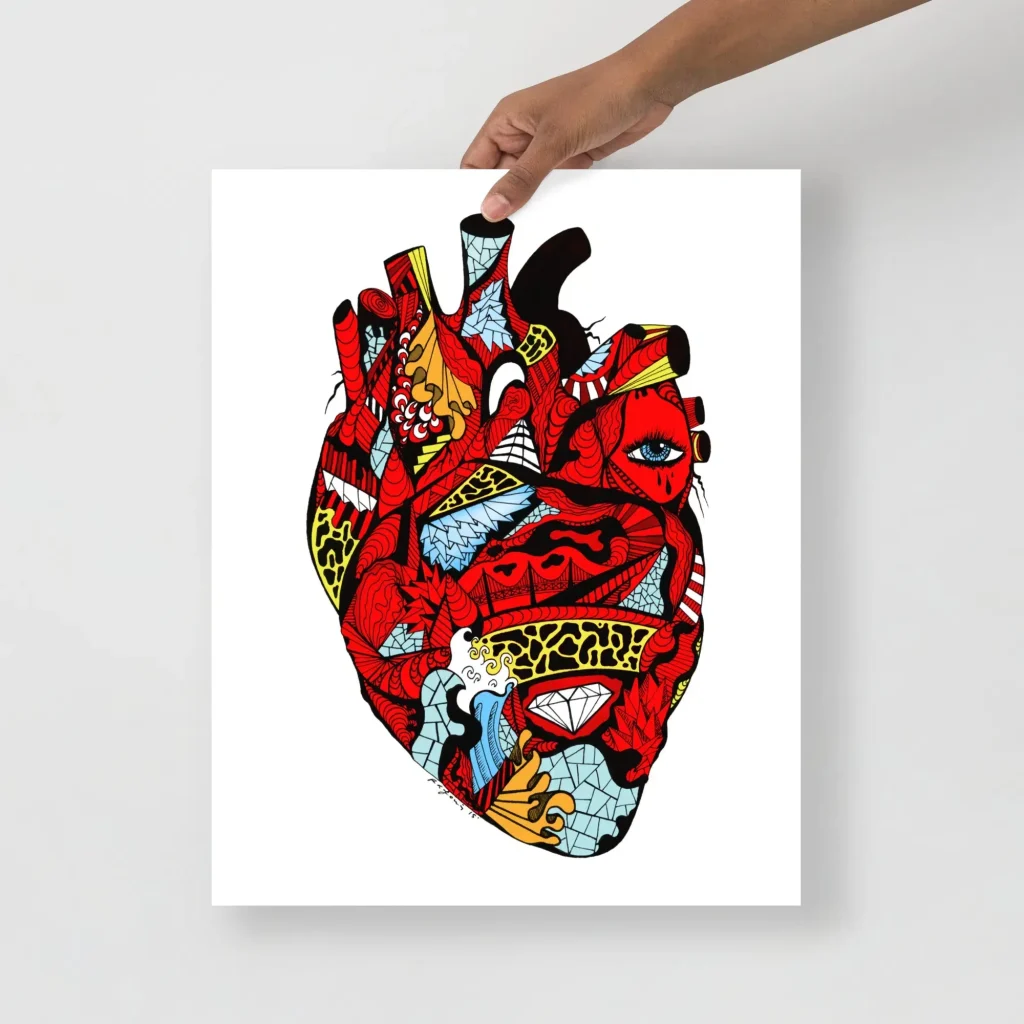
The relationship between these two kinds of mark is what creates the visual tension in the work: the controlled exterior and the fluid interior, locked in constant conversation. Neither would be as strong on its own. The precision of the outer form makes the wildness inside feel contained and intentional, and the organic interior makes those clean outer lines feel like they are holding something back, just barely.
What This Kind of Drawing Can Hold
Built this way — dense, layered interior linework inside an accurate anatomical shape — a piece can hold an enormous amount of feeling without ever stating it outright. The images suggest rather than declare. They invite interpretation instead of dictating it. Someone who has lived through grief sees something different in these marks than someone who is newly, recklessly in love. Both readings are true. Both are held by the same image at the same time.
A heart line drawing from my collection is not a statement about one specific emotion. It is an open form you step into with your own history. The line gives you the structure; you bring the feeling. That exchange between my hand and your inner life is exactly what I am chasing when I sit down with a pen and a blank page.
Made by the Hand, Not the Machine
What separates this work from digitally generated or AI-assisted images is simple: every line was placed by a human hand. The slight shift in pressure. The lived quality of an organic curve. The moments where a stroke thickens or tapers in answer to the natural rhythm of the wrist and fingers. These things only happen when a body meets the pen and the pen meets the page. That human origin sits inside every single line, and I believe people feel it, even when they cannot quite name what they are responding to.
The Long Tradition Behind the Line
This subject has a far longer history than most people realize — from medieval anatomical sketches to Leonardo’s extraordinary studies of the heart, from nineteenth-century scientific illustration to contemporary fine art. My pen and ink work places itself consciously inside that lineage while pushing it somewhere new. I am not making medical diagrams. I am not making decorative valentines. I am making something that lives in the space between anatomy and emotion, between documentation and dream.
Working in this tradition means trusting the expressive power of the line itself. No color. No shading gradients. Just the mark on the page and what it manages to say. That constraint is actually a tremendous kind of freedom, because it forces every stroke to work as hard as it can, to carry as much meaning as a single mark can hold. When you take color out of the equation, the line has nowhere to hide. It either works or it does not. My drawings live in that productive tension between the historical past and the emotional present — and honestly, that tension still excites me every time I pick up the pen.
Shop the Prints at kenallouis.com/
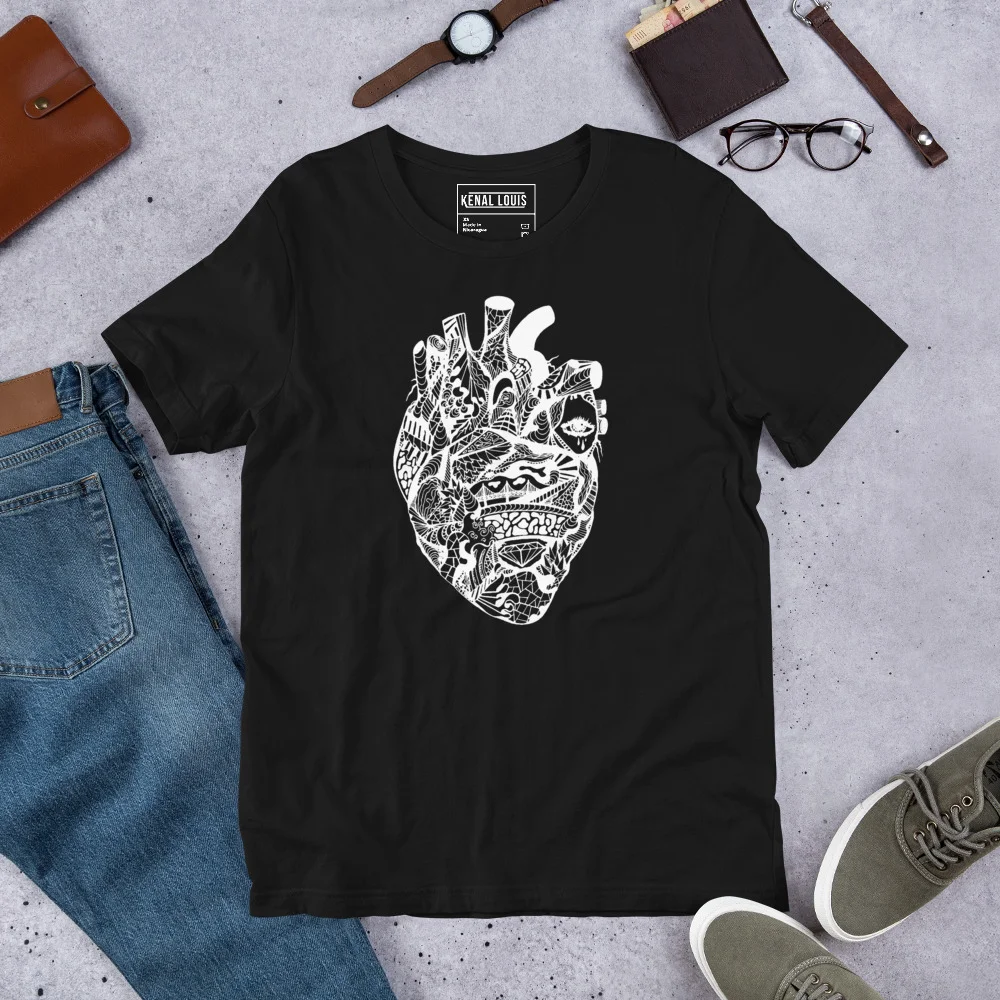
My prints are available as anatomical heart art in fine art prints, canvas wall art, and apparel. Every edition is limited, so it is worth acting while they last. Visit kenallouis.com/ and support a Black artist making original, human-made work about what it means to carry a heart at all.