Where heart drawing Anatomy Crosses Between the Real and the Felt
How do you draw an organ that everyone has felt break, yet almost no one has actually seen? That was the question I kept asking myself while bent over the page. Heart drawing anatomy is, for me, the most fascinating challenge there is, because the subject demands accuracy to the biological form while leaving the interior wide open to something entirely different.
I am Kenal Louis. My work in this area always begins with real engagement with the anatomical form: the chambers, the great vessels, the aortic arch. I want to draw something that is recognizably the real organ, not a stylized approximation of it. The exterior has to earn its biological credibility first. Only then does it have permission to go somewhere else with the interior.
And then it goes somewhere very different indeed.
Two Registers Working at Once
My illustrations operate in two registers at the same time, and the tension between them is what makes the pieces so visually compelling. One register holds the body honest. The other lets the feeling loose.
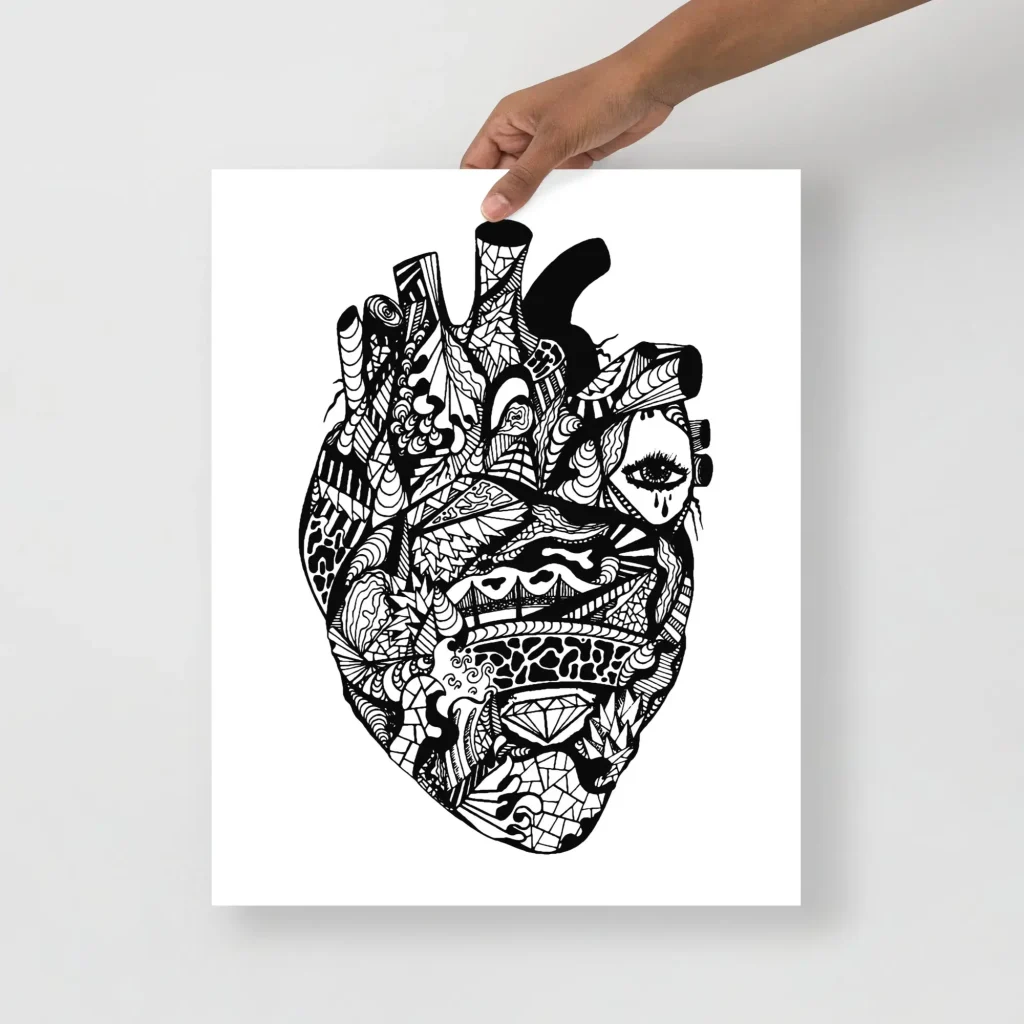
The first register is biological — the exterior form, drawn with care and structural accuracy. The aorta rising boldly from the top. The pulmonary vessels. The broad lower curves of the ventricular walls. The confident lines that establish the real organ. In pieces like my Anatomy heart line art Print, that exterior is rendered with a clean, minimal confidence, every line placed deliberately, nothing wasted.
The second register is emotional — the interior, filled with a dense, flowing world of organic shapes that have nothing to do with biology and everything to do with what it actually feels like to carry a heart around inside you. Botanical forms that push through vessel walls. An eye with a falling tear embedded in a lower chamber. Coiling curves that suggest both living tissue and something deeper — vine and vein, root and river. Crystalline shapes erupting upward from a dark interior field. Dripping ink that hints the heart cannot always contain what it holds. In my Anatomical heart art Print – Transparent Heart Drawing, that interior world is visible through the form itself, as though the organ is solid and permeable at once.
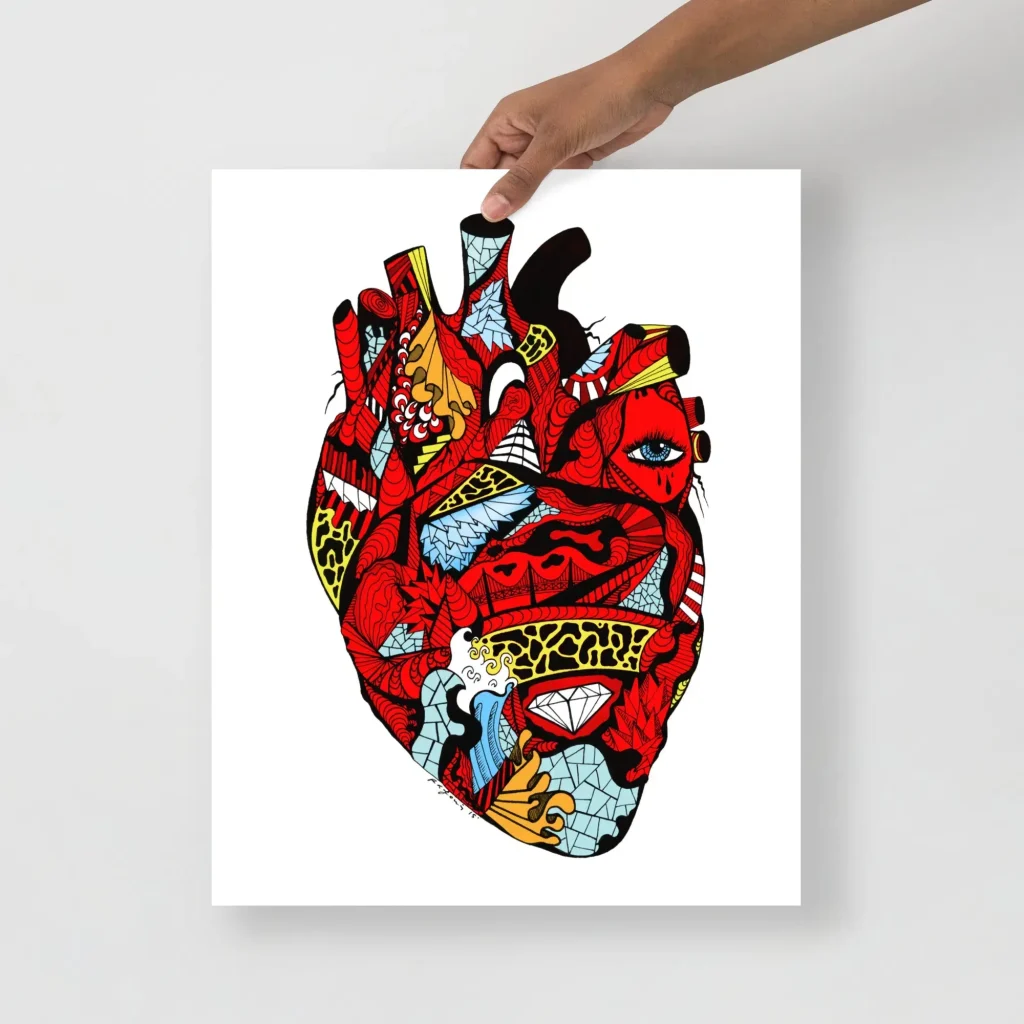
Both registers operate primarily in black and white. The contrast creates all the depth and emotional range the pieces need — shadow and light doing the work that color might otherwise handle, but with a directness and permanence that feels right for this subject.
What This Subject Has Taught Me
Engaging seriously with heart drawing anatomy has taught me things about both dimensions of the work, the biological and the emotional. On the biological side, it deepened my appreciation for the extraordinary complexity of the real organ: the way the chambers nest inside one another, the way the great vessels branch and curve, the way the whole structure is somehow both compact and architecturally intricate. On the emotional side, I learned that the biological complexity of the real heart is actually the best possible container for the emotional complexity I am trying to represent.
The two layers amplify each other. The biological precision grounds the emotional content, and the emotional content gives the biological form meaning beyond its function. Honoring both at once produces more interesting and more truthful work than either pure scientific illustration or pure abstraction could achieve alone. The science makes the feeling credible. The feeling makes the science matter.
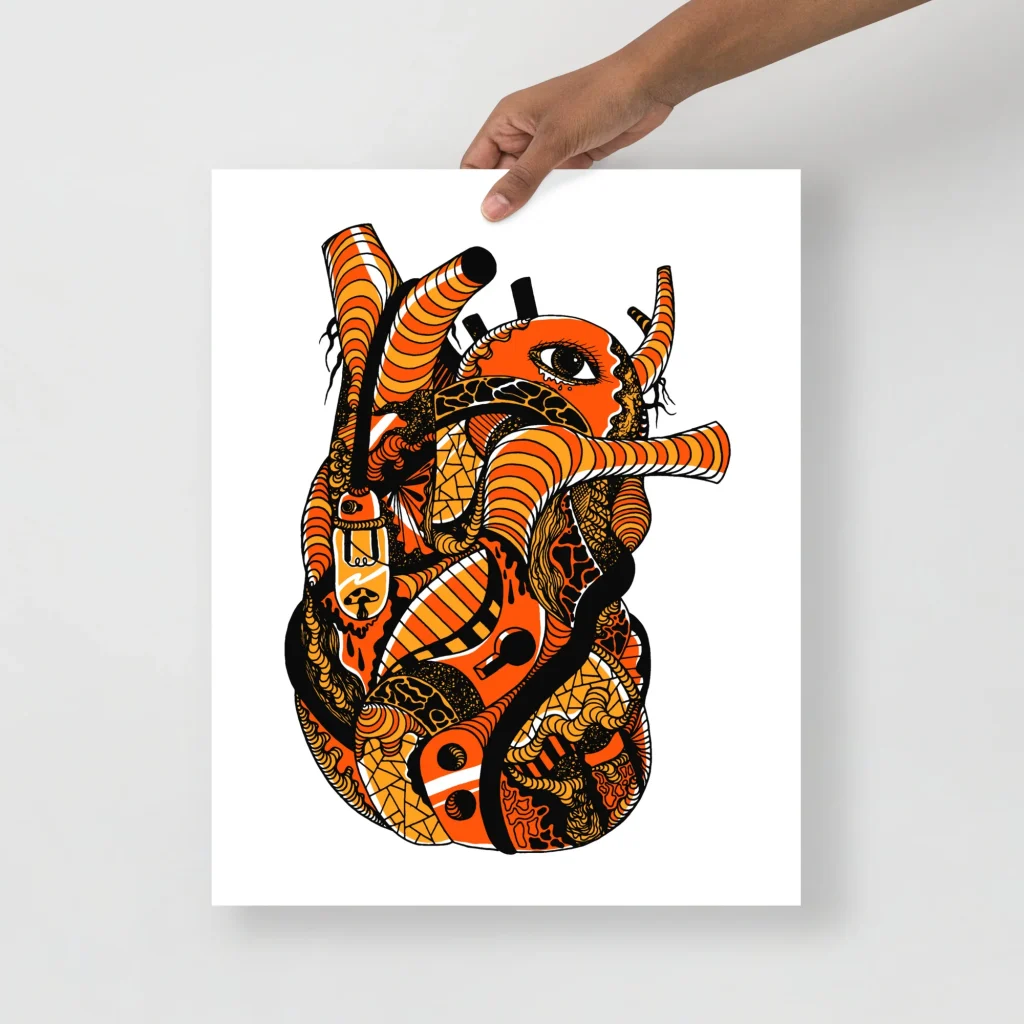
My Anatomical heart art print | orange and black wall art is a good example of what happens when I bring color into this framework. The orange doesn’t soften the exterior — it charges it. The black linework holds the structure, and the orange pushes heat and urgency into the form. It reads as both a biological diagram and something that is very much alive.
The Hours Behind the Drawing
Work like this takes real time. The structural exterior requires patience and care: getting the proportions right, keeping the linework confident without letting it turn mechanical. The interior organic world requires even more. Building the dense, layered linework that gives the chambers their visual weight is slow, deliberate work. Every coiling form, every botanical shape, every dripping line is placed by hand, one decision at a time. The hours spent on a single piece are present in the finished image in a way that cannot be faked — you can feel the accumulation of choices in the density of the marks.
A Starting Point, Not a Destination
For most artists who study the anatomy of the heart, accuracy is the goal. For me, it is only the beginning. The accurate exterior establishes the container. What goes inside that container is the real destination.
If anatomy were the destination, the interior would have to be biologically correct. But because it is the starting point, the interior can be anything: an organic world of flowing forms, a weeping eye, crystalline eruptions, dripping ink. This creates a specific visual tension. The viewer expects biological accuracy throughout. The exterior delivers it. The interior refuses it entirely. That refusal — the way the organic interior diverges from what biology would predict — is where the emotional power lives. The tension is the point.
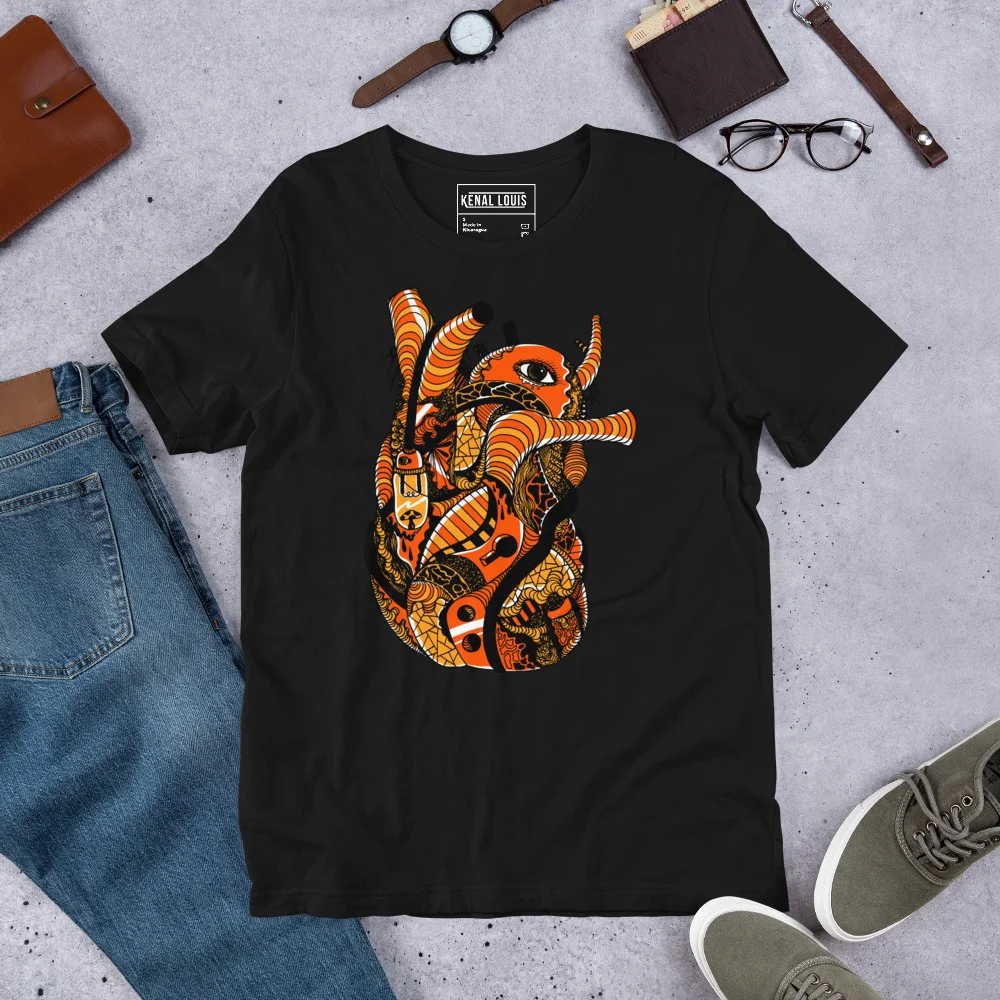
That tension travels beyond the wall, too. My Anatomical Heart Graphic Tee in Black and Orange carries the same logic onto wearable art: the precise exterior, the charged color, the sense that something complex and alive is happening inside the form. Wearing it is a way of carrying that conversation — biological and emotional, scientific and felt — out into the world.
Shop at kenallouis.com/
These prints are available as fine art prints, canvas wall art, and apparel. Every one is limited edition, so if a piece speaks to you, don’t wait too long. If you are choosing for someone you love — a partner who feels deeply, a best friend who wears their heart out loud, a graduate or a healer who lives by the strength of theirs — this art carries real weight and meaning as a present they will remember. Visit kenallouis.com/ and support a Black artist making original work that honors both the science and the soul of the human heart.