
I will be honest about something. For a long time I hesitated to draw hearts at all. The shape felt used up to me — so worn down by greeting cards and stickers that I worried anything I made would just disappear into that pile. So I sat with it. I asked myself what would have to be true for me to draw a heart and actually mean it. The answer changed everything about how I approach the subject.
A Heart Shape Drawing That Goes Past the Symbol
A simple heart shape drawing — the two-humped icon that shows up on every Valentine’s card — has become so common that it barely registers anymore. I see it, I instantly know what it means, and I move right along. There is no pause. No second look. No real moment of encounter.
That is not the kind of heart I make.
The heart in my work begins from the anatomical form — the real biological organ, drawn with its chambers, its vessels, and the strong upward sweep of the aorta — before I fill the interior with a world that demands a second look. And a third. And a fourth.
What Happens When You Go Past the Simple Symbol
When you draw past the icon and into the real form, everything shifts. The anatomical heart is immediately recognizable — people know what they are looking at — but it is not so familiar that they stop looking. It holds the eye. It creates that productive tension between recognition and strangeness that good art needs to survive. The viewer leans in instead of moving on.
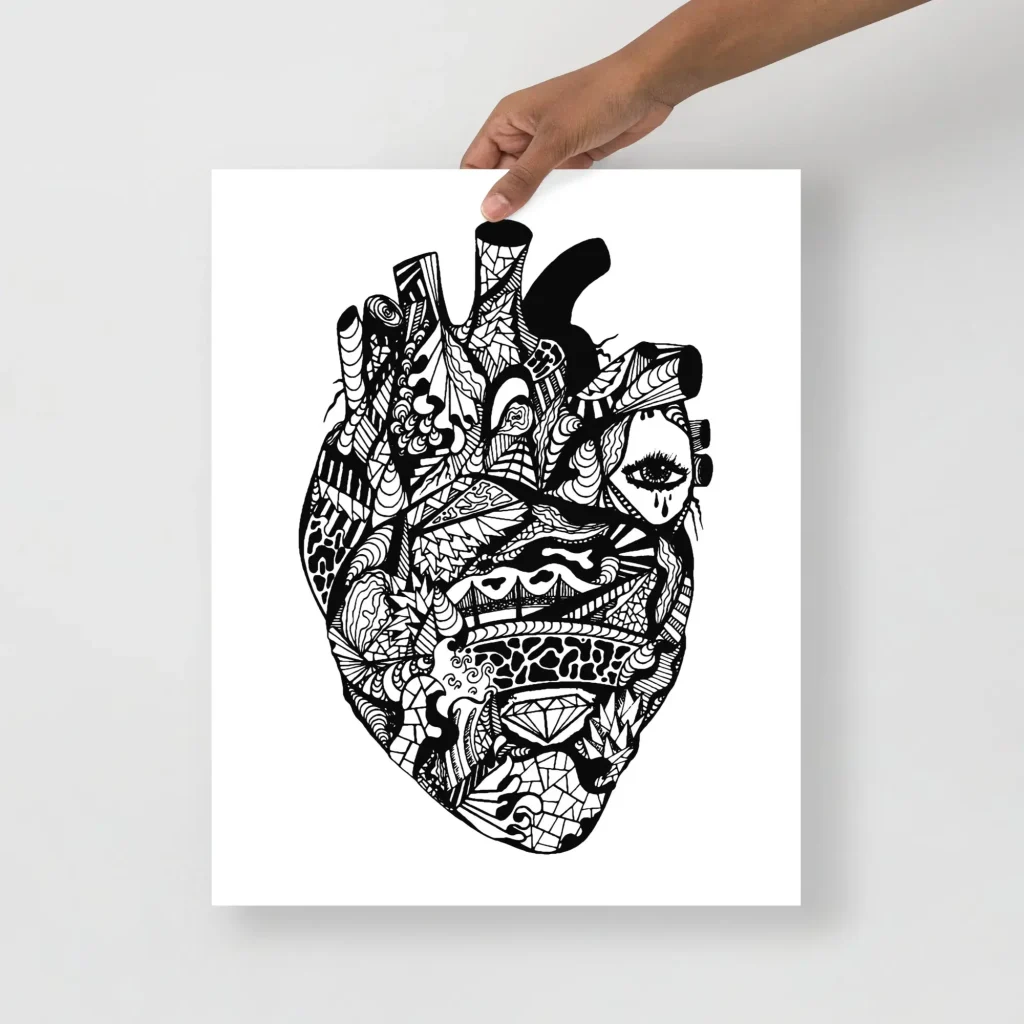
The interior of my drawing fills with heart abstract art that breaks from the familiar entirely. In my Anatomy heart line art Print, organic textures flow and coil across the chambers while botanical forms grow out from within the vessel walls. A weeping eye looks outward from a chamber, as if the heart itself has learned how to witness. A diamond rests at the base. In my Anatomical heart art Print — Transparent heart drawing, an entire circular world is held inside the form: crystals, flowing organic shapes, dripping ink, and a central seeing eye, all rendered so the layers beneath stay visible through the form itself. That transparency is not only a visual choice — it is a statement about how much the heart carries and how little of it we usually allow to show.
This work is always black and white pen and ink. The lines do all the work. The contrast carries all the depth. There is no color to lean on, no gradient to soften a hard edge. Every single mark has to earn its place on the page.
A Heart Shape Drawing as an Emotional Document
What I am always reaching for with a heart shape drawing is not a symbol of love. I am trying to create a document — a visual record of what it actually feels like to carry a heart in the full sense of the word. The griefs it holds. The things that somehow grow in it anyway. The way it keeps seeing and feeling even when it is worn out from both. The icon cannot hold any of that. The anatomical form, filled with the right interior world, can.
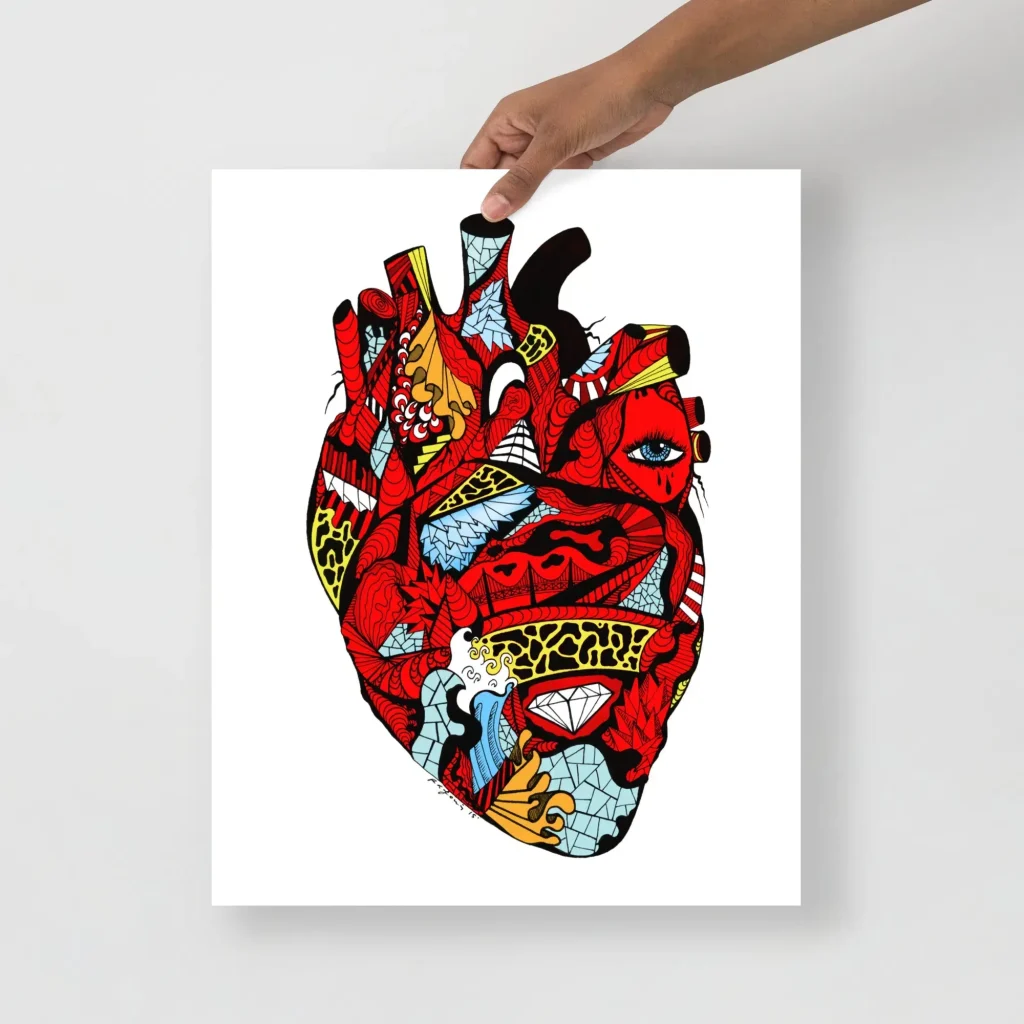
I start from the anatomical form because that is the honest form. The real heart is not symmetrical and smooth. It is muscular, lopsided, and full of chambers that serve different purposes. Starting there — with the truth of the organ — means the drawing already carries a kind of integrity before I add a single interior detail. And then the interior does the rest: it turns the honest form into something that speaks differently to every person who stands in front of it.
The Simple Version Is Not Enough
Let me be clear about one thing. The simple version has its place. It is a powerful shorthand, and I am not dismissing it. But when an artist chooses to take the heart seriously as a subject, the icon is only the doorway. The real work — the one that explores anatomical heart art — goes all the way inside. That is what I try to do. I take the most recognizable shape in our whole visual language of emotion and ask what happens when you refuse to stop at the outline.
A Heart Shape Drawing as an Invitation
Even the complex, anatomically grounded version I create works as an invitation. The recognizable form draws the viewer in — everyone knows the shape on sight. But the interior is not what anyone expects, and that gap between expectation and discovery is exactly where the real experience of the piece lives.
Whoever looks closely finds an organic world full of real questions. What is the eye doing inside the chamber? What does the tear mean? Why are botanical forms pushing through the vessel walls? These questions have no single, settled answer. Each viewer responds from their own history — their own seasons of grief and growth and the strange way feeling refuses to quit. I design the work to be completed by the viewer rather than closed by the artist. That, to me, is the art that lasts — the kind that gives something back every time you come back to it.
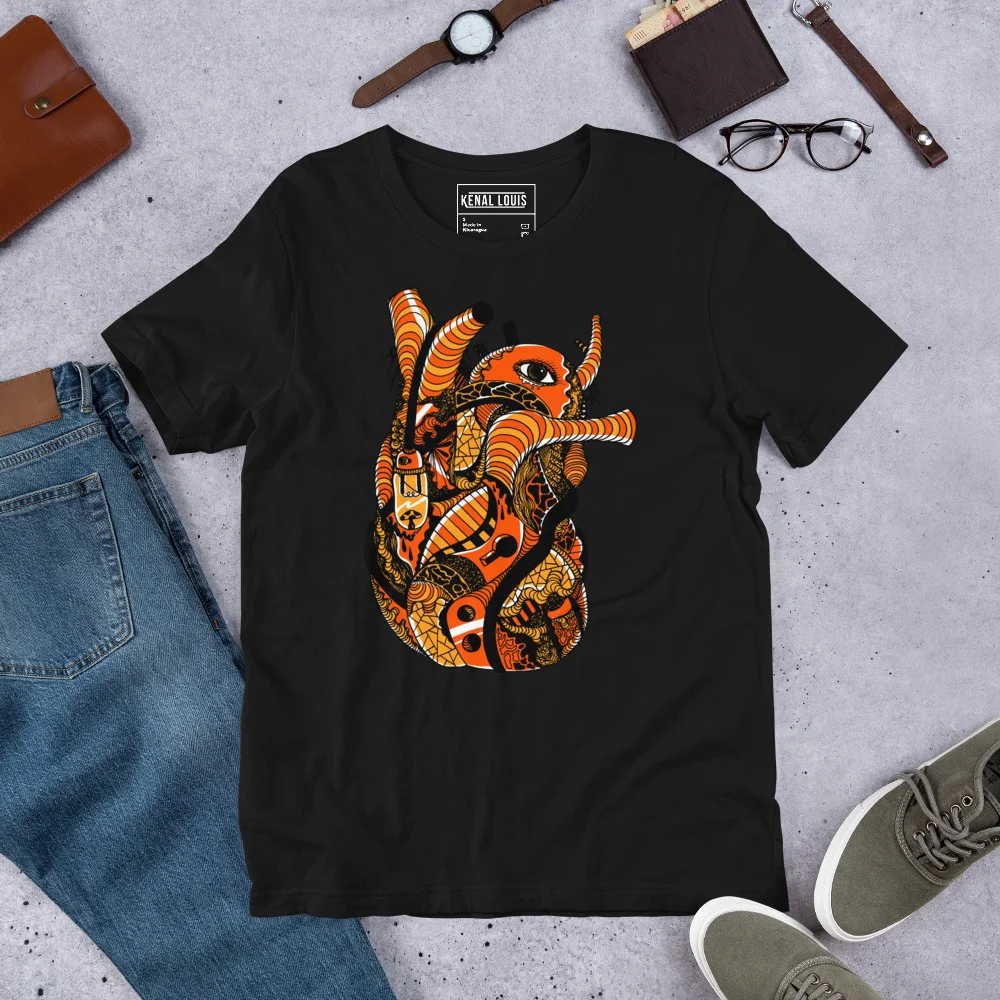
That same philosophy reaches into the wearable work too. My Anatomical Heart Graphic Tee in Black and Orange carries the same form onto a garment, so the image moves through the world on a body instead of hanging still on a wall. The bold orange against black gives it an energy the fine art prints reach in their own quieter way — but the core commitment is identical. The form is real, the interior is complex, and the whole thing asks more of you than a simple icon ever could.
This is also why these pieces mean something as a gift. When you give a partner or a lover a piece like this, you are not handing them a tidy little symbol — you are handing them a record of everything a heart actually holds. It works just as well for a friend going through a hard season, or for anyone who has loved and lost and kept going anyway. I think the right moment to give it is whenever words feel too small for what you are trying to say.
Shop Heart Shape Drawing Prints at kenallouis.com/
My prints are available as fine art prints, canvas wall art, and apparel. They are all limited edition — so if something speaks to you, do not wait too long. Visit kenallouis.com/ and support a Black artist making original heart art that goes all the way past the icon and into something that genuinely lasts.
In the end, I keep returning to the heart because it is the one shape we all carry inside us, and the one we understand least. If a drawing of mine makes someone pause long enough to feel the weight of their own — the grief, the growth, the stubborn beauty of still feeling at all — then it has done the work I hoped for. That is the legacy I want these lines to leave behind.