
An African Tribal Mask That Carries Ancestral Power
A face built from line, pattern, and silence — that is where every one of these drawings begins. An African tribal mask is one of the most symbolically loaded objects in all of human art history, and rendering one in pen and ink is one of the most demanding things I do as an illustrator.
The mask tradition across the African continent spans hundreds of distinct cultures and thousands of years. Each mask was purpose-built — for ceremony, for initiation, for communion with the ancestral world, for marking transitions that could not be crossed without spiritual preparation. So when I sit down to draw one of these masks, I know I am drawing an object that was always meant to do real work in the world. That weight stays with me through every stroke.
How I Approach an African Tribal Mask in Pen and Ink
My process starts with the structure of the face. The proportions are often deliberately exaggerated in ways that serve the mask’s ceremonial purpose rather than naturalistic accuracy. The placement of the eyes. The width of the nose. The heaviness of the mouth. Every decision is intentional, rooted in what the mask is meant to say rather than what a human face simply happens to look like.
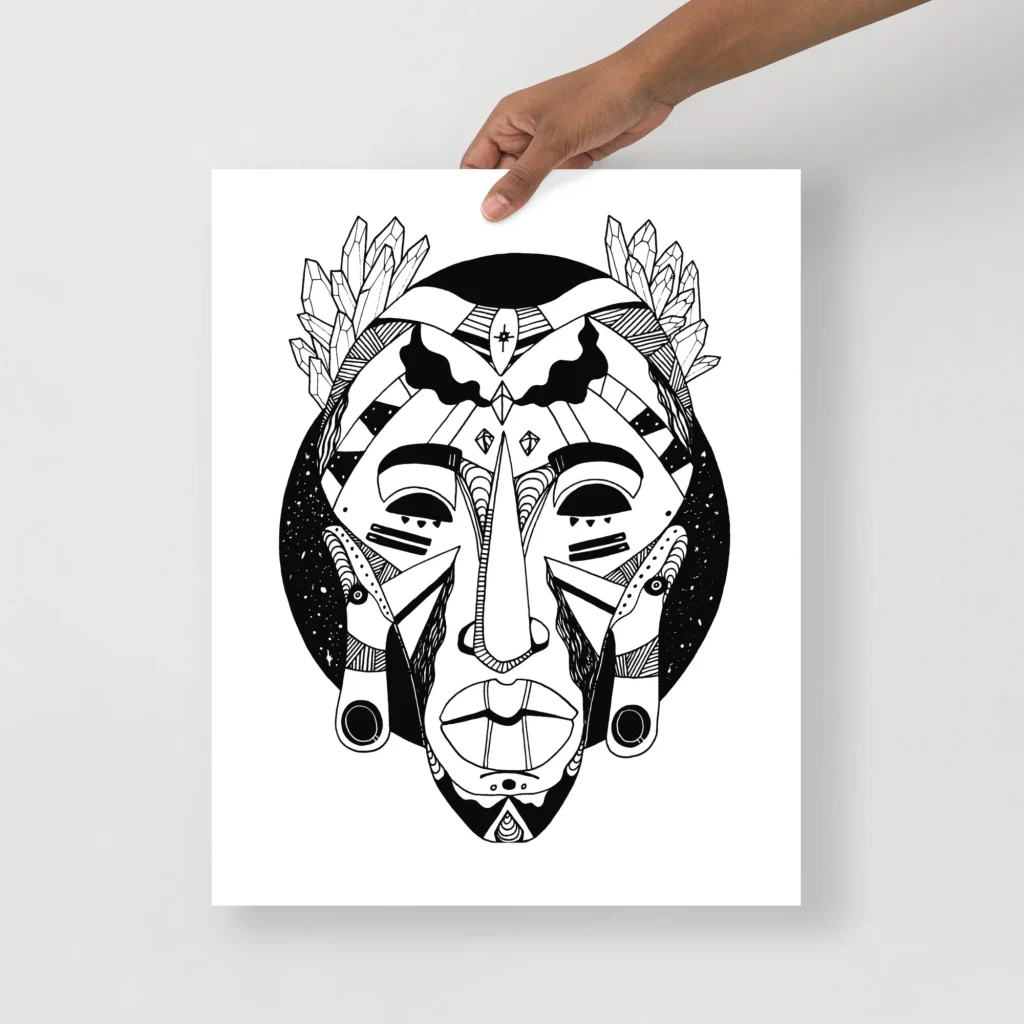
Then I build the surface — the geometric patterns that fill every plane of the face, the crosshatching and line-fill textures that give the drawing its density. This is the stage where the image truly becomes its own world. The patterns are not decorative in any casual sense. They are a visual language, and I treat them that way, placing each line with the understanding that pattern in this tradition carries meaning, not just beauty.
From there I add the headdress. In many of my pieces it takes the form of crystal formations rising above the forehead, or feathers fanning outward against a circular black background. These elements draw on the specific vocabulary of West African ceremonial masks, where the headdress signals the identity and power of the spiritual force the mask represents. It is the part of the composition that lifts the image from a portrait into an icon.
What Makes These Pieces Different
There are plenty of mask images circulating commercially. Most are either photographs of artifacts or generic illustrations that treat the tradition as decoration rather than heritage. They borrow the look without engaging with what any of it means.
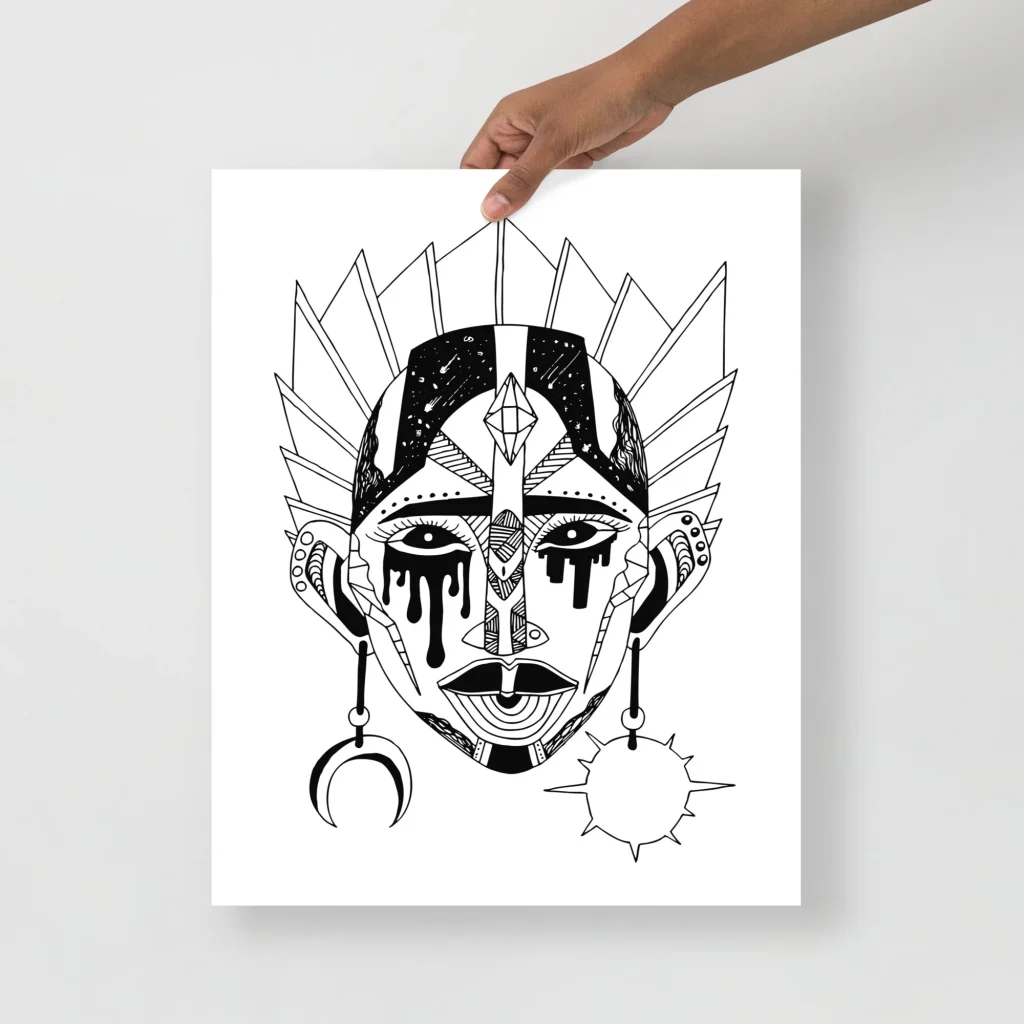
My pen and ink African tribal mask drawings are something else entirely. They are made by hand, with full awareness of what they draw from, by a Black artist creating this work as an act of cultural celebration. That distinction matters — not only philosophically but visually. You can feel the intentionality in the line work itself.
The Power of Black and White
I keep these pieces in black and white on purpose, because color would risk turning them into exotic objects rather than living visual culture. Stripped to ink alone, the image holds its power directly — through line, form, and symbol. Nothing softens it. Nothing distracts from it.
The absence of color makes the mask more present, not less. The stark contrast between dense ink work and the open white of the paper creates a tension that keeps pulling the eye back in. It is the same reason the great woodblock prints and engravings of art history still work so well — reduction to essentials forces the image to be honest about what it is.
What These Pieces Look Like in Homes
When one of these prints goes up on a wall, it creates a particular kind of presence that I find genuinely moving to witness. The bold contrast reads clearly from across the room. The crystal headdress and geometric patterns reward close inspection. The circular black backdrop gives the image a sense of inner depth — as though the face is emerging from something rather than simply sitting against a flat surface.
An African tribal mask rendered in pen and ink suits almost any interior. Against a white wall, the contrast is dramatic and commanding. Against a dark wall, the bright paper glows. The geometric patterns find harmony with the lines already in a room — shelving, frames, the edges of furniture — instead of fighting them. These are not difficult pieces to place. They carry a self-assurance that lets them work in a wide range of spaces.
They are not difficult pieces to live with, either. A drawing like this settles into its space with authority and keeps offering something new each time you look closely. The more time you spend with it, the more you notice — a line tucked inside another line, a pattern that quietly echoes one three inches away, a detail in the headdress that only reveals itself when the light hits the paper at a certain angle.
Own an African Tribal Mask Print Today
My prints are available as fine art paper editions, canvas wall art, and apparel. Every run is limited. Once a run sells through, it is gone — I do not reprint indefinitely, because part of what makes these pieces worth owning is that they are not mass-produced objects. A framed print also makes a meaningful gesture for someone you love, whether it is a sister reconnecting with her roots, a friend moving into a first home, or anyone marking a season of growth — the kind of present that says you saw them clearly.
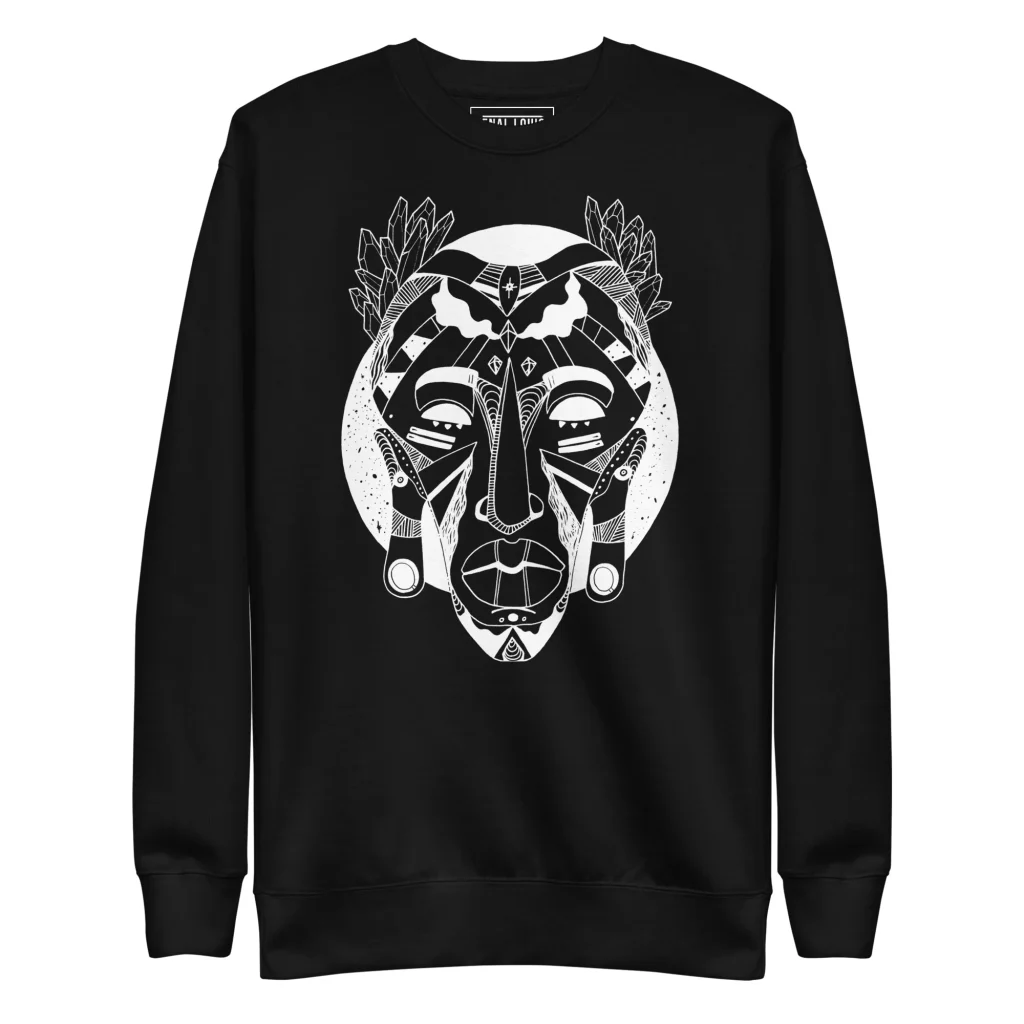
African Mask Sweatshirt - White Line Art Afrocentric Pullover
Support a Black Artist Honoring African Heritage
When you purchase one of these prints, you are supporting original, human-made art created specifically to celebrate African culture. Each piece is drawn entirely by hand — no filters, no digital shortcuts, no stock imagery reworked into something new. This is pen on paper, line by line, in the tradition of illustrators who believed the hand should always be present in the work. Visit kenallouis.com/ and find the piece meant for you — the same face that began as line, pattern, and silence, now waiting for a wall.