
Heart abstract art That Lives Between Two Realities
I want this work to give you a feeling of being seen — not your face or your name, but the quiet machinery of your inner life. Heart abstract art occupies one of the most fascinating spaces in illustration: the territory between the biological and the emotional, between what the heart physically is and what the heart has always meant to us.
I live in that territory on purpose. When I draw a heart in pen and ink, I am drawing two things at the same moment — the physical organ with its chambers, its vessels, and the bold arc of the aorta, alongside the interior emotional world that the organ holds and pushes outward. My heart abstract art comes from refusing to let either reality cancel the other out. Both stay in the frame, breathing against each other.
The Two Layers of My Heart Abstract Art
The first layer is the anatomical structure — the real form, drawn with biological accuracy. The shape a cardiologist would recognize. The form that is beating in your chest right now as you read this sentence. I never soften or simplify the outer silhouette. I want you to know instantly that you are looking at a true heart: the aorta arching upward, the ventricles curving down, the whole shape carrying the weight of something that genuinely keeps people alive.
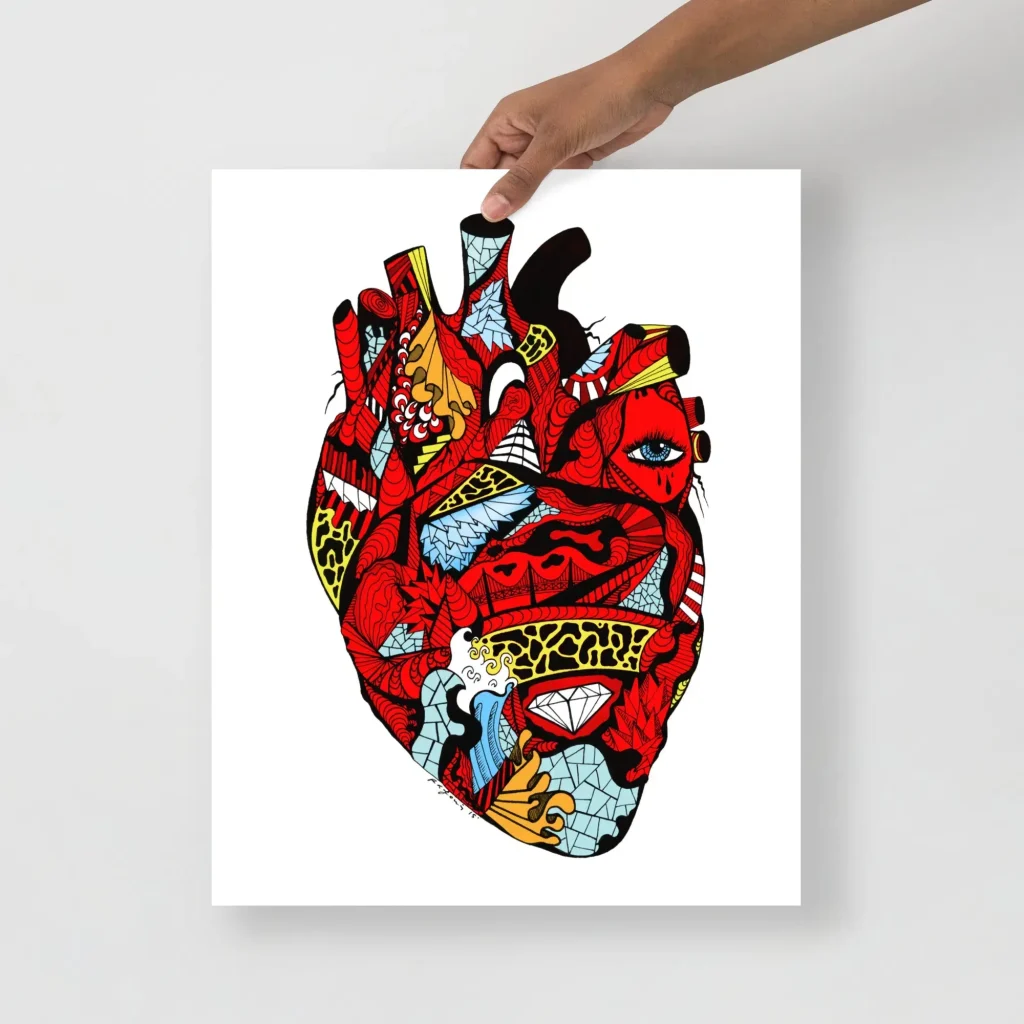
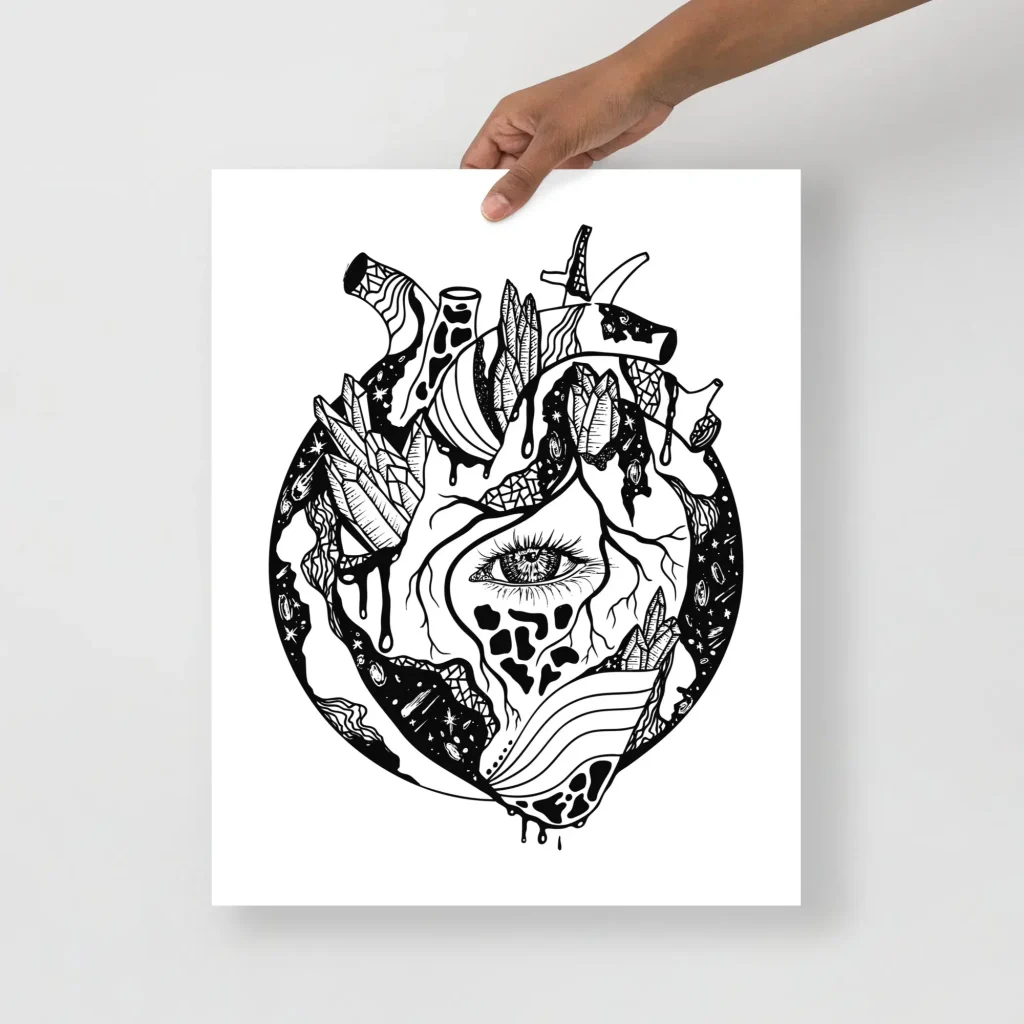
The second layer is where the abstraction begins. Inside that accurate form, the interior fills with a world of flowing organic shapes — surfaces that ripple and shift, botanical elements pushing through the vessel walls, cool heart drawings with coiling curves that suggest motion and growth at once. In one piece, an eye sits embedded within the chambers, looking outward and carrying a single tear — a quiet, unsettling detail that rewards anyone who leans in close. In another, the form holds an eruption of crystalline shapes rising over a dark, dripping base, with a central eye radiating out like the pupil of something ancient and enormous. Every drawing builds its own interior, and no two are alike.
The relationship between these layers is what gives the work its pull. A realistic container wrapped around an abstract interior creates a tension that keeps the eye moving — in and out, between the familiar and the strange, between anatomy and imagination. None of that is accidental. It is the entire reason I draw these.
Why I Keep It in Black and White Ink
My choice to render all of my heart abstract art in black and white ink came from thinking hard about what color would quietly remove. Color assigns meaning. It tells you how to feel before you get the chance to decide for yourself. But this kind of work, at its best, should hand the emotional interpretation back to you entirely — the drawing gives the form, the structure, and the detail, and the person standing in front of it brings the feeling.
Black and white keeps everything open. The dense black fills set against the white paper, the fine white lines pulled out of dark fields, the gradations built only from ink pressure and line weight — all of it creates rhythm and depth without dictating a mood. The same image can read as grief to one person and resilience to another, as longing to one viewer and pure wonder to the next. That openness is not a weakness of the work. It is one of its greatest gifts to whoever owns it.
Art That Belongs to Everyone Who Looks at It
There is something else this approach does that genuinely moves me. It lets the image belong to the viewer in a way color rarely allows. When you bring your own emotional history to what Black art collectors bring a hand-drawn heart, you fill in everything I left unspecified. The piece becomes yours — shaped by your memories, your losses, your loves, your particular way of seeing the world. That is one of the most generous things any artwork can do: leave room for the person looking to step all the way inside.
How These Drawings Function on a Wall
A piece from this collection behaves differently in a room than most wall art, because it works on two registers at the same time. From across the space, the bold anatomical silhouette reads instantly — the dark aorta, the strong lower curves of the ventricles, the circular dark field anchoring the composition. It lands as a coherent, powerful statement from a distance. You know what you are looking at, and you feel its presence, before you have taken a single step toward it.
Up close is where the full complexity opens. The organic interior — the flowing surfaces, the weeping eye, the crystalline eruptions, the ink pooling and dripping at the base — needs proximity to be fully felt. And the closer you get, the more you find. New forms surface out of the dense linework. New relationships between shapes reveal themselves. Details you missed on the first look appear on the fifth. The drawing keeps offering something new at every distance and in every kind of light, which means it never settles into background decoration. It stays alive on the wall.
Because it lives in black and white, this heart abstract art also sits comfortably in almost any room. It does not argue with your color scheme or compete with your furniture and textiles for attention. Instead it brings visual weight, intellectual depth, and real emotional presence to whatever wall it hangs on. Minimal and modern or warm and layered, it fits — and lifts the space a little. That quality is also part of why these pieces make such a thoughtful gift: a framed print like this speaks to anyone drawn to meaning over decoration, and I have shipped them to people honoring a parent, marking a recovery, or simply choosing something true for a father who would never ask for anything for himself.
Own Heart Abstract Art at kenallouis.com/
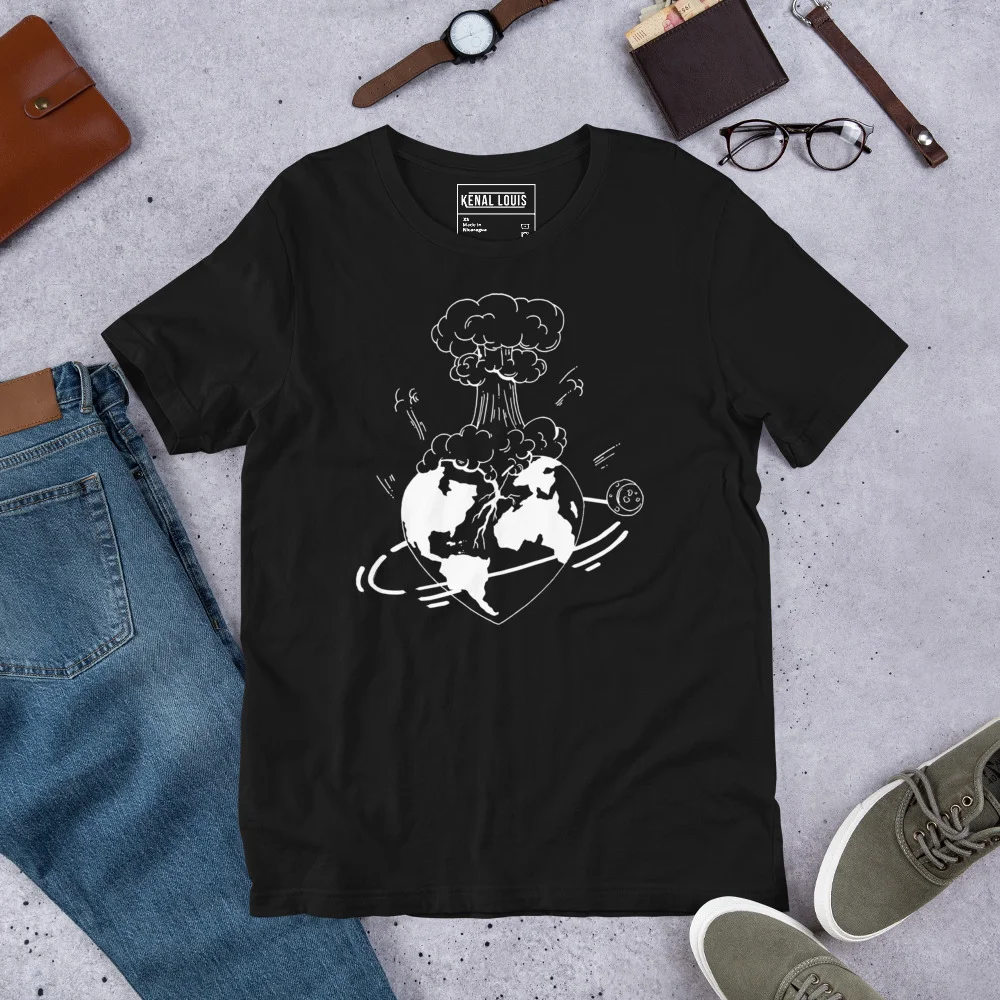
My prints are available as fine art prints, canvas wall art, and apparel — including graphic tees that carry the same hand-drawn ink work into wearable form. Every piece is limited edition, so the supply is genuinely finite. Visit kenallouis.com/ to browse the full collection and support a Black artist making original, hand-drawn work about the interior life of the human heart. Each piece arrives ready to live on your wall or be worn on your body — and every one of them was drawn entirely by hand, one line at a time.
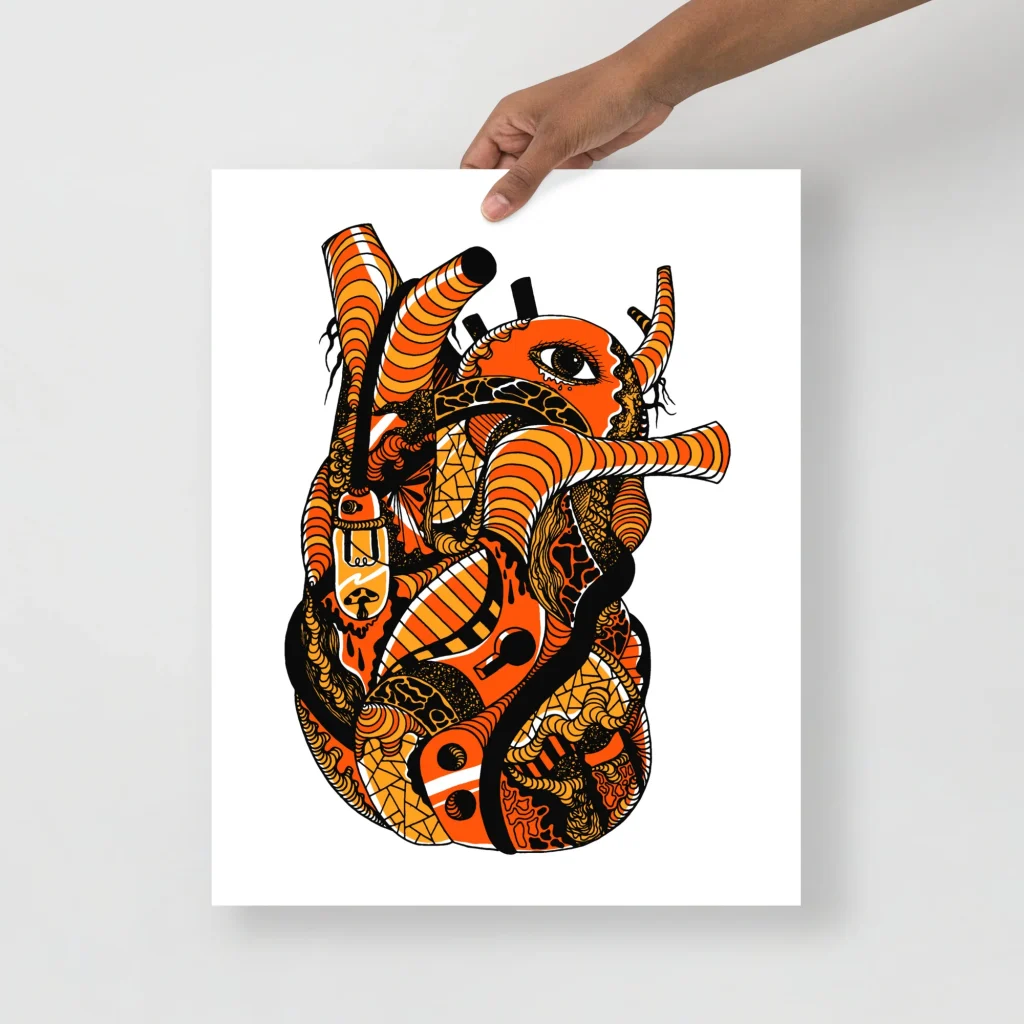
This is a series I plan to keep growing, one heart at a time, as long as there are feelings worth turning into ink.