
Drawings of African Masks That Carry Real Weight
A mask staring back at you from the page, every plane filled with geometry, every line laid down by a human hand — that is what I set out to make. The best drawings of African masks are not illustrations of objects. They are interpretations of a living visual tradition that deserves genuine artistic engagement.
That is the standard I hold my pen and ink work to. Everything I make in this series is created entirely by hand — no AI, no digital generation, no color. Just the pen, the page, and a deep respect for the tradition I am drawing from. Three decades of drawing taught me that shortcuts always show up in the final piece, so I refuse to take them here.
What Makes a Strong Mask Drawing
Strong drawings of African masks share a few qualities. They honor the expressive proportions of the mask tradition — the deliberate elongation, the exaggerated features, the geometric logic of the surface patterns. They capture the headdress elements that place the mask in a ceremonial rather than simply decorative context. And they communicate some quality of the energy that traditional masks were designed to channel.
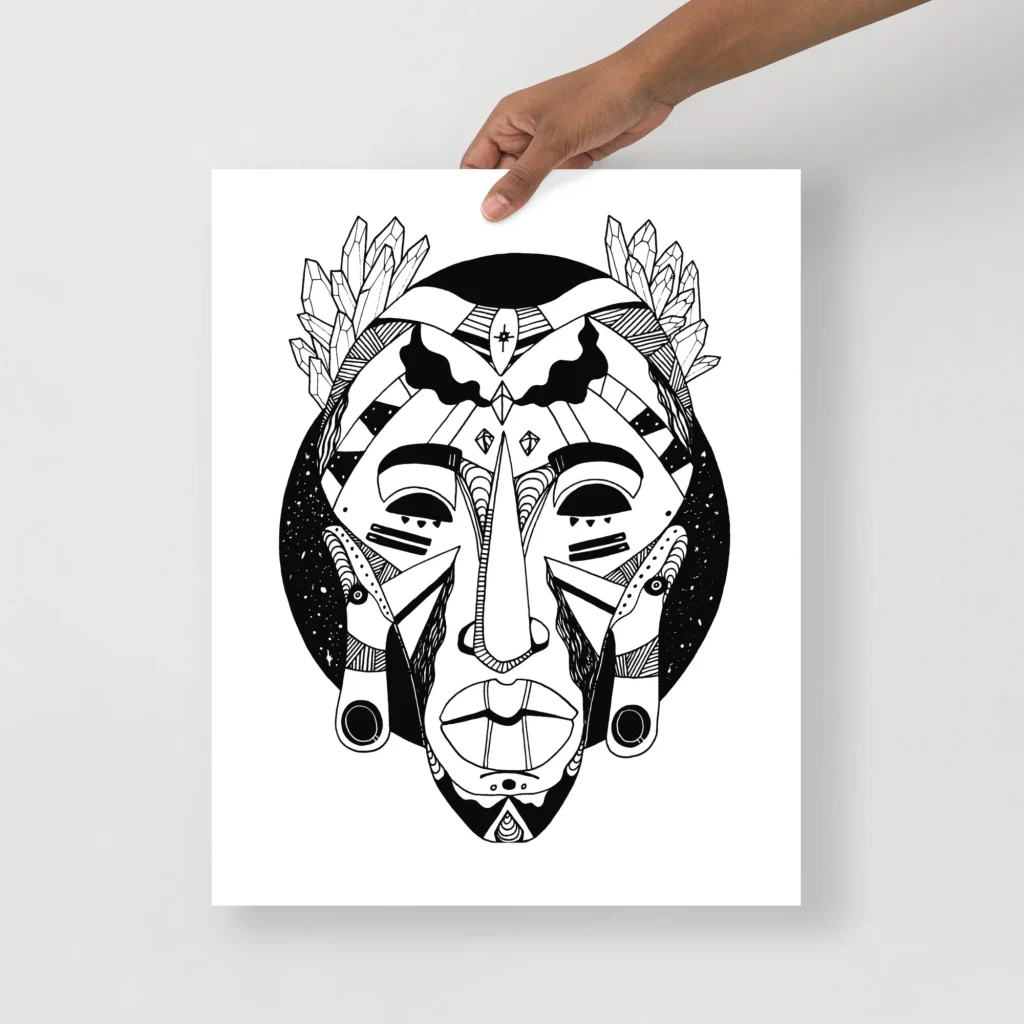
I work toward all of this through black and white African mask art created with careful, intentional linework built entirely by hand. The faces carry bold geometric patterns laid down line by line across every plane of the surface. Crystal and feather headdresses rise above the forehead. A starry circular backdrop grounds each piece in something larger than a portrait — something that feels ceremonial rather than decorative.
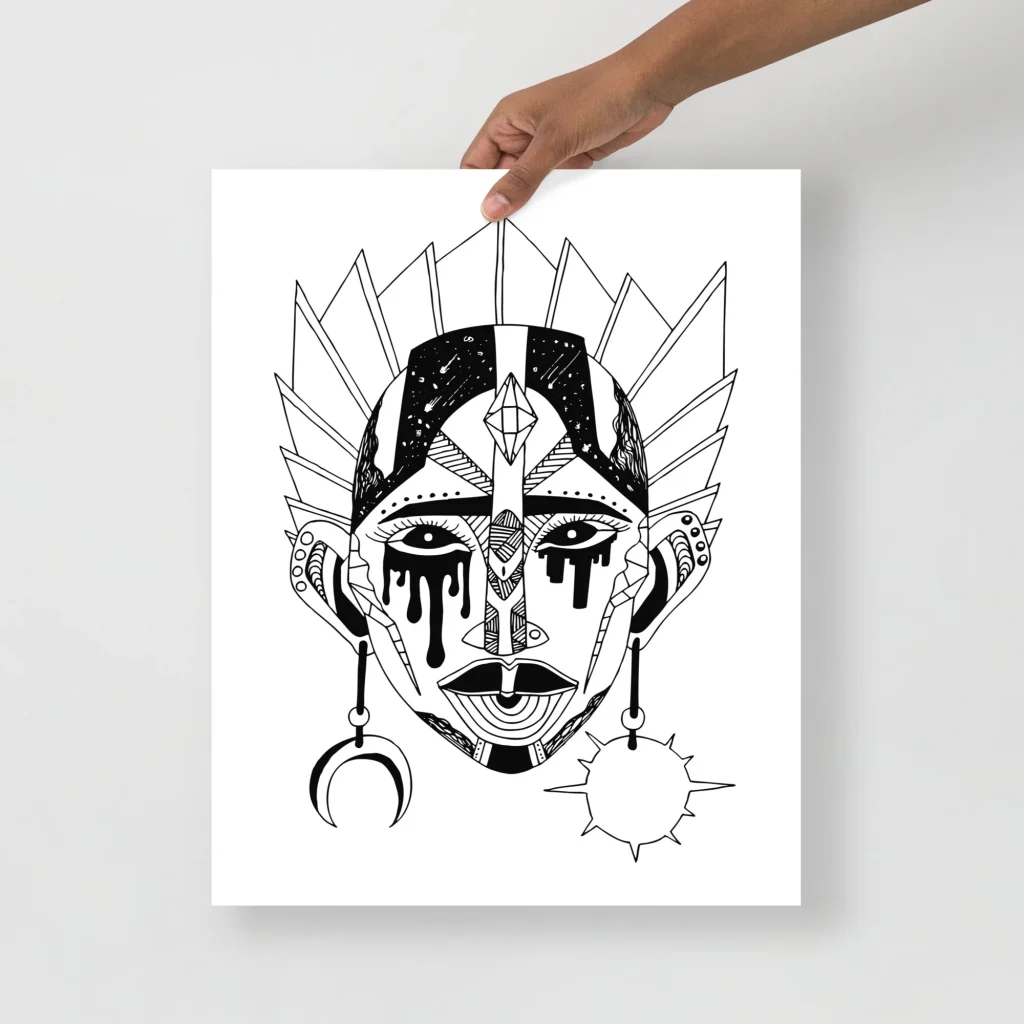
Some of these pieces also carry sun and moon symbolism — celestial imagery that draws on the deep connection between african mask traditions and the broader spiritual frameworks of African and African-diaspora cultures. These are not decorative choices. They are deliberate references to a cosmology that has always been present in the tradition, and I want them felt rather than just seen.
The Process Behind Each Piece
My work always begins with careful structural drawing. I sketch the basic proportions first — the relationship between forehead, eyes, nose, and mouth, the width and depth of the face, the placement of the headdress above the crown. Getting this foundation right is what lets everything that follows feel grounded and intentional.
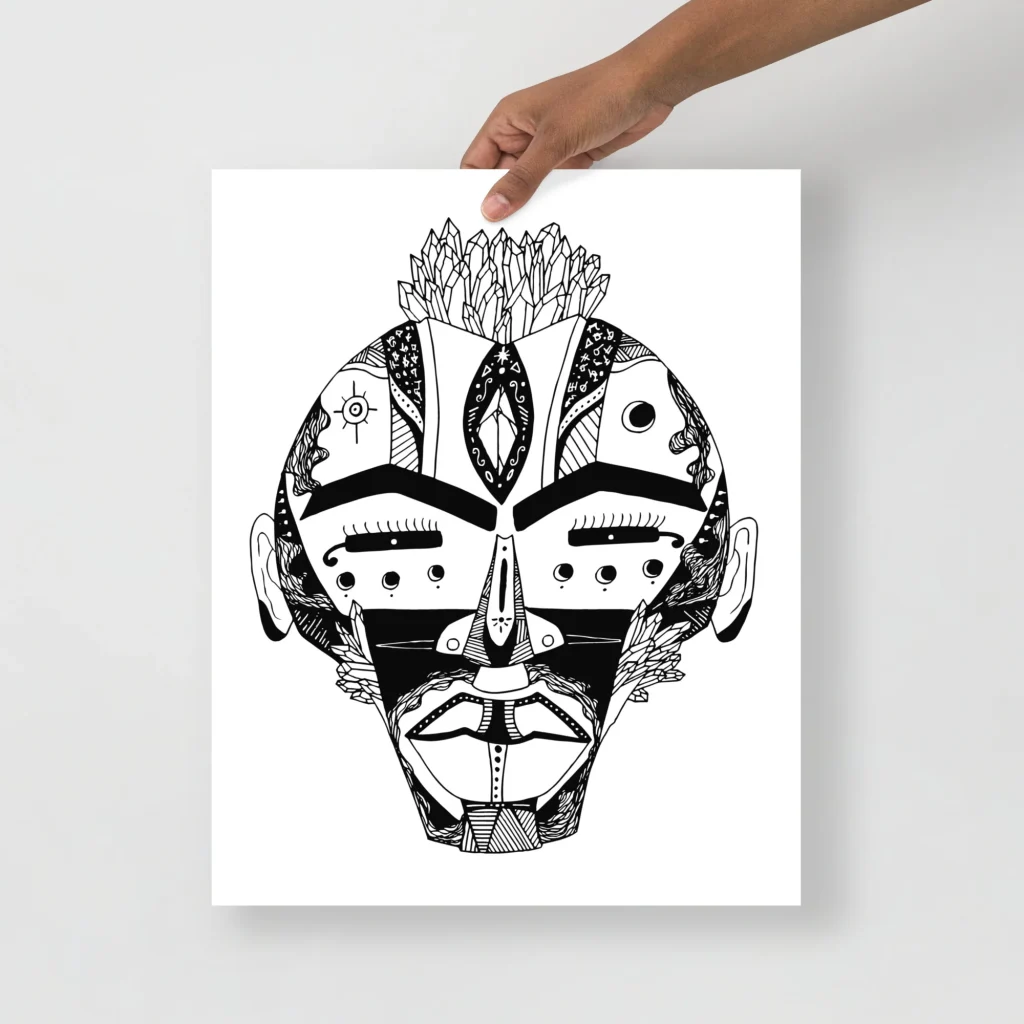
Then I begin the surface patterns. This is the most time-consuming part of the whole process — the linework that fills every plane of the face with geometric texture. A single mask drawing can involve hundreds of individual marks, each placed on purpose. There is no shortcut to this. You either put in the time or the page tells on you.
Each finished piece carries the evidence of real time and real attention. That is not something a machine can replicate, and it is not something I am willing to compromise on.
Why I Keep Them in Black and White
I made the decision to stay in black and white on purpose, because it forces the image to communicate through form alone. The geometry does the work. The symbol carries the meaning. Color would only distract from that directness.
Pen and ink also feels more connected to the original objects these drawings reference — because like those objects, they rely on form rather than color to carry their power. The stark contrast between the dense ink marks and the open white of the page creates a visual tension that keeps the eye moving across the surface. That tension is part of what makes these pieces work as wall art as much as they work as drawings.
Why These Drawings Belong in Contemporary Collections
Drawings of African masks have a role to play in contemporary art collections that photographs of artifacts and generic stock illustrations simply cannot fill. A photograph of an african mask is a document. A genuine artistic interpretation — pen and ink made with cultural awareness and real craft — is a statement about the ongoing relevance and power of the tradition.
When this work is created by a Black artist engaging with the material from a place of cultural investment, it becomes something else again — an act of representation that says this tradition belongs in contemporary spaces, on contemporary walls, in the daily visual lives of people who care about art that carries meaning. That is what I am trying to do with every piece I make.
Black and white pen and ink also has a visual clarity and boldness that makes it exceptionally effective as wall art. The stark contrast reads from across a room. The dense geometric patterns reward close inspection. And the ceremonial headdresses create vertical visual interest that lets the pieces fill their space with authority. These are not quiet works — they announce themselves, and they hold their ground.
Shop My Drawings of African Masks at kenallouis.com/
My work in this series is available as fine art prints, canvas wall art, and apparel. All editions are limited — once they sell out, they are gone for good. If a piece speaks to you, do not wait on it.
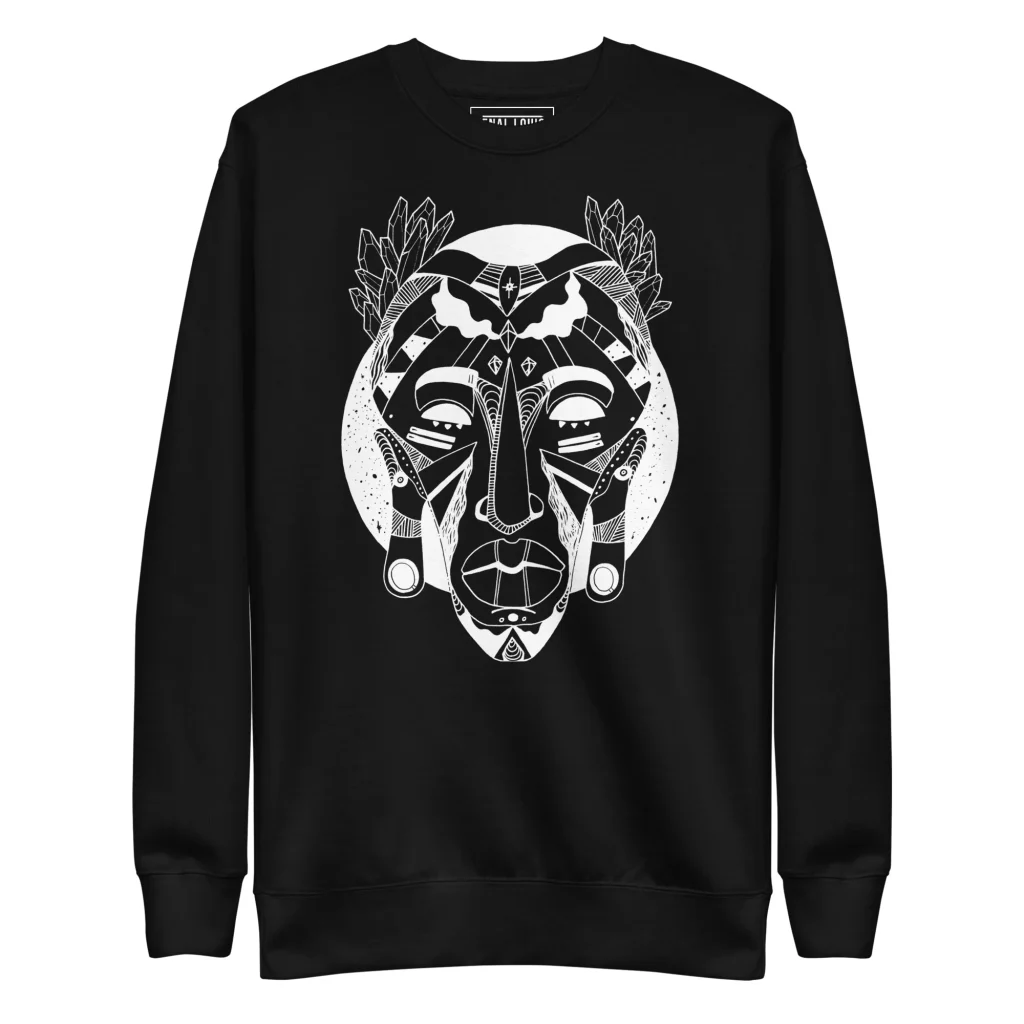
African Mask Sweatshirt - White Line Art Afrocentric Pullover
Support African Heritage Through Art
Visit kenallouis.com/ and find the drawing that speaks to you. If you are choosing for someone you love — a friend who collects, a parent who values heritage, a partner setting up a first real home — one of these pieces says something a quick present never could. Every purchase supports a Black artist making original, human-made work in honor of African culture, and these pieces are built to last: on a wall, in a collection, and in the conversation about what contemporary african art looks like.