
“The essence of drawing is the line exploring space.” – Andy Goldsworthy
I still remember the first night I filled a page with lines that meant nothing at all. No face, no figure, no object — just marks chasing one another across the paper at my studio desk. I expected to feel lost without a subject. Instead, I felt free. That single page taught me more about balance than any reference photo ever had.
Understanding Balance Through Abstraction
There is a hidden power in abstract art that reveals proportion. When you create things to draw that have no literal subject, the work stops imitating the world and starts revealing structure. My line art explores how shapes relate to one another without representing anything specific — and that freedom is exactly what makes it such a rich space for learning proportion.
Golden Ratios in Abstract Form
Proportion lives naturally inside abstract patterns. When I sit down to draw, I find myself exploring:
- Spirals that follow Fibonacci sequences
- Rectangles nesting within golden-mean proportions
- Circles decreasing in careful mathematical progression
These pen drawings sit among the most inspiring things to draw because they teach proportion intuitively, not through rules you memorize. Abstract work is especially powerful for this kind of study. It highlights the relationships between elements without the distraction of recognizable imagery — you see the structure itself, nothing else, and your eye learns faster for it.
Rhythm and Spacing Lessons
Empty space teaches just as much as filled space does, and abstract art makes that truth impossible to ignore. Lines congregate and then disperse. Patterns grow dense and then open up into breathing room. Proportion emerges from that contrast — from the push and pull between presence and absence on the page. The white of the paper is never empty; it is doing work.
Even simple things to draw when you’re bored become genuine proportion studies when you approach them with that awareness. Abstract ink drawings reveal weight distribution and visual balance in a way that works on you almost unconsciously. You feel when something is right long before you can explain why.
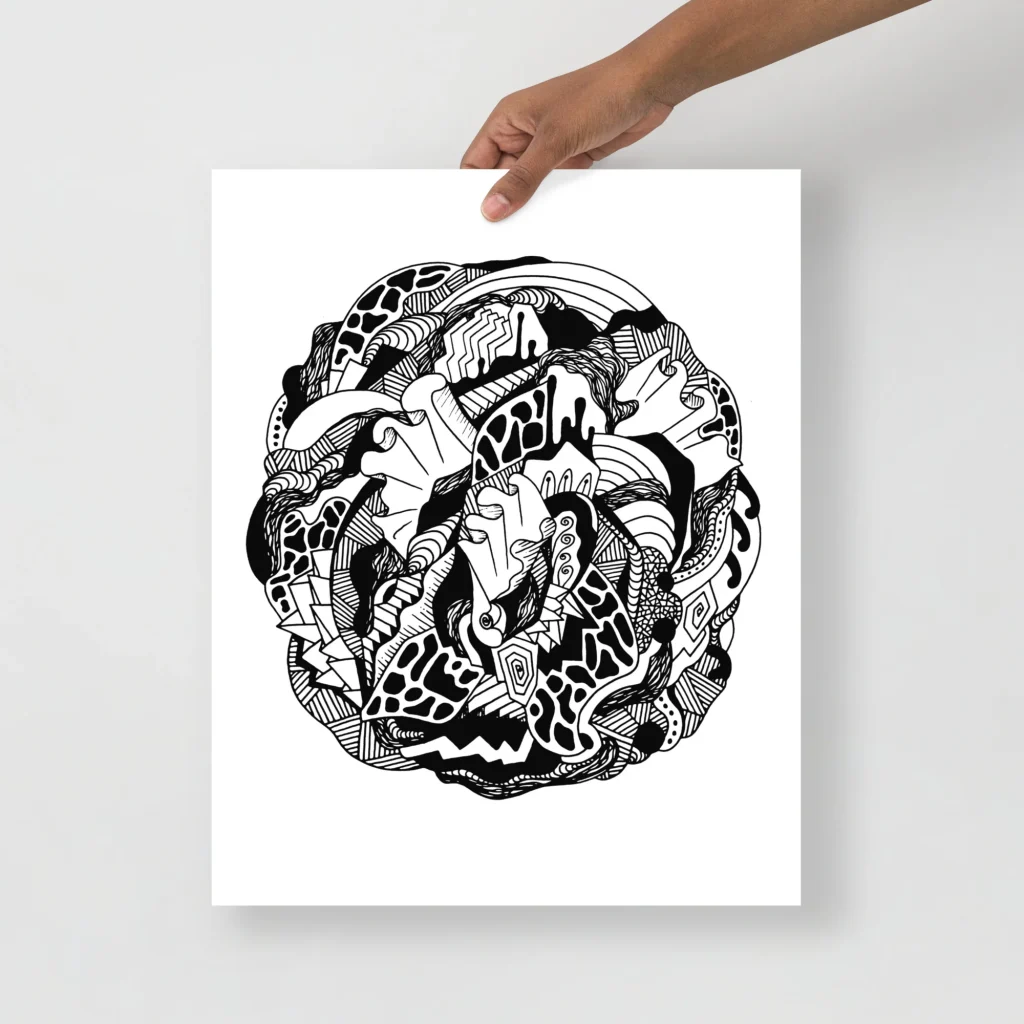
Mathematical Beauty
Abstract line art demonstrates proportion through a handful of principles I return to again and again:
- Systematic size variations that guide the eye across the composition
- Intentional spacing intervals that create rhythm and breathing room
- Balanced asymmetry that feels dynamic rather than static
Learning Through Pure Pattern
Try this: draw marks that seem random at first, then pause and observe the relationships forming between them. Anything you add to a drawing should account for the proportions already on the page — every new mark is a conversation with what came before it. Beautiful abstracts feel beautiful precisely because they understand mathematical harmony, even when that understanding is intuitive rather than calculated.
The most fun things to draw are often the ones that work on the viewer subtly, and line art is exactly that. Drawing without recognizable subjects forces you to focus entirely on the fundamentals — scale, weight, interval, balance. Every single mark affects the whole, and that accountability sharpens your eye faster than almost any other practice I know.
Proportion as Expression
My proportion-focused pieces started out as exercises. I was simply trying to understand why certain compositions felt resolved and others felt restless. But those exercises revealed something bigger: balance is not just a technical achievement — it is the source of beauty itself. Over time, every abstract piece I make has become, in its own quiet way, a proportion masterclass.
Pen drawings that explore proportion feel deeply satisfying to look at, and that is how abstract art transforms spaces and connects emotionally with the people living in them. Viewers sense a rightness in the composition without ever needing to name it. The mathematics disappears into the feeling. Structure becomes emotion through art, and that transformation is what keeps me coming back to the page night after night.
Bring that proportional harmony into your own space with my abstract prints. Let these carefully balanced pieces train your eye to recognize and appreciate visual relationships — on the wall and in your own drawing practice. My hope is that whoever hangs one of these on their wall feels a little more grounded each time they walk past it, the way a balanced line quietly settles a room.